
Last Updated: November 21, 2026
Quick Summary
Research peptide quality means the vial matches its stated identity, strength and purity, and the batch-specific certificate of analysis is the main way to verify it. Check that the lot number matches your vial, confirm the identity and purity methods are stated, and authenticate the report directly with the testing laboratory. A GMP label alone does not prove any individual batch passed testing.
- Confirm the certificate of analysis lot number matches the label on your vial.
- Identity should be confirmed by mass spectrometry, and purity usually by HPLC.
- Contact the testing laboratory directly using contact details from its own website.
- Check that the testing laboratory holds ISO/IEC 17025 accreditation for the specific tests reported.
- A GMP label does not prove that a specific batch passed release testing.
Table of Contents
- How to Verify a Peptide COA Line by Line
- Peptide Purity Testing Methods Compared: HPLC, Mass Spectrometry, and Endotoxin
- GMP Grade Peptide Certification: What the Label Does and Does Not Guarantee
- A Reproducible Scoring Rubric for Comparing Suppliers
- Research Peptide Supplier Quality Checklist for Your Next Order
- Booking Your First Verified Order With BLACK HAT PEPTIDE COMPANY
- Frequently Asked Questions
Most suppliers publish some form of documentation, but the content varies widely. Some post a generic sheet that applies to a whole product line. Others provide a batch-specific report tied to the lot you actually receive.
Quality is usually judged on several separate measures:
- Identity: whether the molecule is the one named on the label, usually confirmed by mass spectrometry.
- Purity: the share of the sample that is the target peptide, usually measured by HPLC.
- Content: how much peptide is actually present per vial, which is not the same as purity.
- Safety-related testing: endotoxin and sterility results, which matter for some research uses.
A reasonable rule is to treat a claim without a matching test as unverified, and a test without a lot number as unverified too.
How to Verify a Peptide COA Line by Line
A certificate of analysis is only useful if you read it against your specific order and then confirm the document is genuine. You can view the lab reports and certificates of analysis for selected products on our testing and COA page to compare against your own documents. Most buyers stop at the lot number.
Start with the lot number printed on the report and compare it to the label on your vial. If the numbers do not match, the document describes a different batch, and it cannot vouch for yours.
Authenticating the Report Itself
A PDF is easy to edit, so treat any COA you did not receive directly from the testing laboratory as unverified until you confirm it another way. Practical checks:
- Contact the laboratory directly. Use the phone number or email published on the lab's own website, not the contact details printed on the COA, and ask the lab to confirm the report number, lot number, and test results. A legitimate lab will usually confirm whether a report it issued matches what you were given.
- Match report identifiers. Look for a report or job number, a testing date, and a method reference. Ask the supplier for the same identifiers so the two documents can be cross-checked.
- Check for internal consistency. The peptide name, molecular formula, and measured mass should agree with each other. A mass that does not match the stated peptide is a red flag regardless of how clean the rest of the document looks.
- Look for signs of a template. Identical wording, fonts, or layout across unrelated products, or a report with no lot-specific data, suggests a generic sheet rather than a batch record.
Watch out: a supplier that cannot or will not connect you with the named laboratory is telling you something about how much weight the report can carry.
Verifying the Laboratory Is Independent
A report is only as strong as the lab behind it. Ask whether the laboratory is independent of the supplier or owned by it, and whether it is accredited for the specific tests reported.
Also check scope. Accreditation applies to specific tests, so confirm that the methods on your COA fall within the lab's accredited scope rather than assuming the whole lab is covered.
Reading the Method Details
A useful COA states the method for each result, not just the number. For purity, that means the chromatographic method and conditions; for identity, the mass spectrometry technique and the observed versus expected mass. A report that lists a purity percentage without a method, or an identity result without a measured mass, gives you a claim rather than evidence. The full field-by-field walkthrough is in our guide, READ THE REPORT.MATCH THE LOT..
What a COA Does Not Establish
Even a well-authenticated, batch-specific COA has limits. Purity and identity testing do not establish sterility, endotoxin levels, residual solvents, heavy metals, or suitability for human use. If your research requires those attributes, ask for the specific tests and results rather than inferring them from a purity figure. Treating a clean HPLC trace as a broader safety clearance is one of the most common misreadings of a COA.
Peptide Purity Testing Methods Compared: HPLC, Mass Spectrometry, and Endotoxin
Three methods show up on most documents, and each answers a different question. HPLC, or high-performance liquid chromatography, separates the sample into components so you can measure how much of the peak belongs to the target peptide. Mass spectrometry measures the molecular mass of the compounds, which helps confirm identity. Endotoxin testing looks for bacterial endotoxins, which can affect experiments even when purity looks high.
Use these methods together. A high purity result without an identity check cannot confirm the target molecule. An identity match without purity data says nothing about how much else is in the vial.
What HPLC Purity Does and Does Not Tell You
HPLC purity is a percentage of the peaks on a chromatogram that belong to the main peptide. It is a useful signal of how clean the synthesis was. It does not confirm that the main peak is the peptide you ordered, and it does not reveal contaminants that co-elute with it. Read the chromatogram itself when you can, and check that the report states the column and conditions used.
Identity Testing with LC-MS and Its Limits
LC-MS couples liquid chromatography with mass spectrometry, so you see both separation and molecular mass. A matching mass is strong evidence of identity, but it is not proof on its own. Isomers and some modified forms can share a mass, so identity testing works best alongside purity data and a clear method description.
GMP Grade Peptide Certification: What the Label Does and Does Not Guarantee
The term GMP, or good manufacturing practice, describes a set of production and quality-system standards. A product labeled GMP grade signals that the maker claims to follow those standards. The label does not, by itself, prove that a specific batch passed a particular test, and it does not tell you which standard the maker is claiming to meet.
Which Standard Is Being Claimed
GMP is not a single document (the FDA). Drug manufacturing standards are set out in regulation and enforced by the Food and Drug Administration, while international harmonized guidance for active pharmaceutical ingredients appears in ICH Q7. A supplier claiming GMP grade should be able to say which framework applies and how its facility is held to it. Without that, the label is a marketing term rather than a verifiable status.
What Evidence Backs a GMP Claim
Ask for the evidence behind any certification claim. Useful items include:
- Facility and audit information. Who audited the facility, when, and against which standard. A current audit report or certificate with an expiry date is more useful than a logo.
- Batch records and release testing. Confirmation that the specific lot was tested and released against written specifications, not just that the facility operates under a quality system.
- Deviation and out-of-specification handling. How the maker responds when a batch fails a test is a strong signal of whether the quality system is real.
- Chain of custody. Where the material was synthesized, who tested it, and how it reached you.
If a supplier cannot show how the claim applies to the lot you are buying, treat the label as marketing until proven otherwise.
Research Materials Are Not Approved Medicines
A GMP label on a research peptide does not make the product an approved drug, and it does not mean the material is suitable for human use. Research-use-only materials are sold for laboratory investigation, and the documentation that accompanies them should be read in that context. A certificate of analysis and a GMP claim describe manufacturing and testing controls; they do not establish safety, efficacy, or regulatory approval for any therapeutic use.
A Practical Test for Any Certification Claim
Ask three questions of every certification claim: which standard, which auditor, and which batch. A supplier that can answer all three with documents you can check has given you something verifiable. A supplier that answers with a logo and a homepage sentence has not.
A Reproducible Scoring Rubric for Comparing Suppliers
A simple rubric keeps supplier comparisons consistent. Score each supplier from 0 to 2 on each criterion, then total the points:
| Criterion | 0 points | 1 point | 2 points |
|---|---|---|---|
| Batch-specific COA | None or generic only | Some batches | Every lot, lot number matched |
| Identity method stated | Not stated | Method named, no data | Method and measured mass shown |
| Purity method and value | Not stated | Value only | Method, value and chromatogram |
| Testing lab named | Not named | Named, no contact | Named with verifiable details |
| Endotoxin or sterility data | None | Claimed only | Results reported |
| Live inventory accuracy | Unclear | Sometimes accurate | Confirmed before ordering |
Apply the rubric to the documents you actually receive, not to the claims on a homepage. Re-score a supplier whenever its documentation changes.
Research Peptide Supplier Quality Checklist for Your Next Order
Before placing an order, work through this checklist:
- Confirm the COA is batch-specific and the lot number matches the product.
- Verify the stated identity method and measured mass.
- Check that purity is reported with its method and date.
- Confirm the testing laboratory is named.
- Review any endotoxin or sterility results that apply to your use.
- Check live inventory before you pay, so the order matches stock on hand.
- Confirm the research-use terms and shipping details.
Frequently asked questions about inventory, payment and shipping are answered on our FREQUENTLY ASKEDQUESTIONS page, and it is worth reading before your first order.
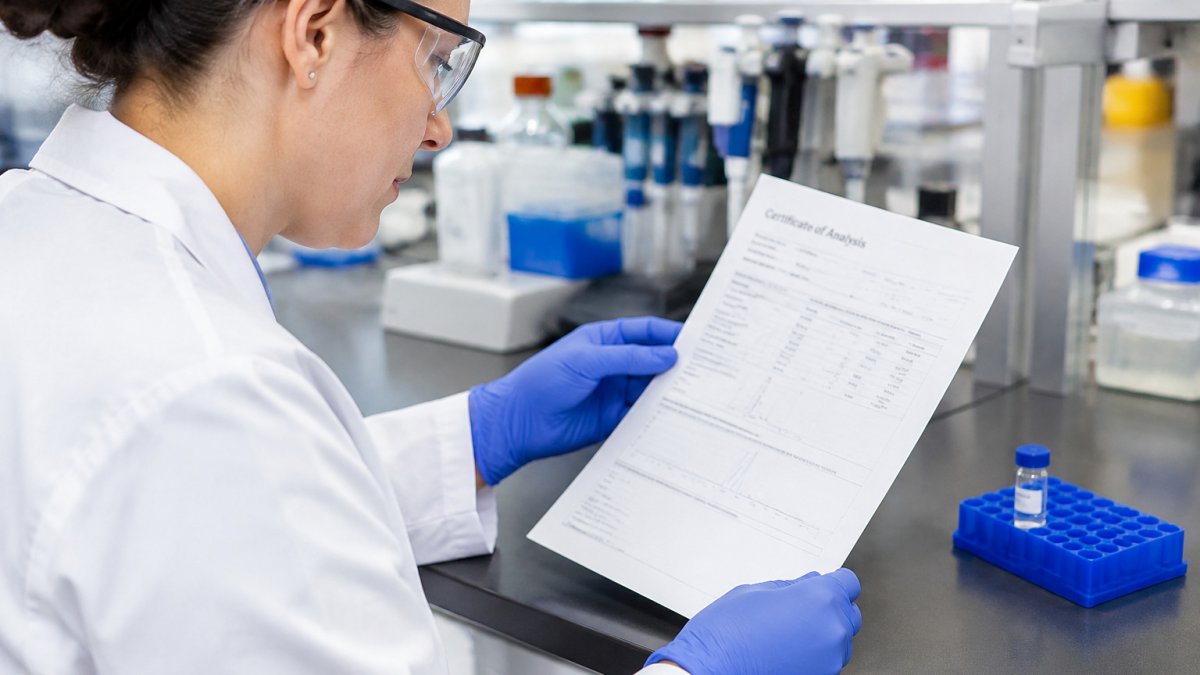
!A laboratory manager in a clean US research lab reviewing a printed certificate of analysis beside a sealed vial in a rack
Booking Your First Verified Order With BLACK HAT PEPTIDE COMPANY
Start by reading our Research Use Disclaimer so you understand the restrictions that apply to every purchase. Then follow the How to Order from Black Hat steps to select products, complete checkout and pay immediately by card, Venmo, Zelle, BTC through BTCPay or ACH transfer.
Once you have a verified order in hand, compare its documents against the checklist above. If a COA does not match your lot, contact the supplier before you use the material. Contact the supplier directly if a document does not match what arrives.
Frequently Asked Questions
What is the best website to compare research peptides?
No single website is the best for every researcher. Useful starting points compare published certificates of analysis, third-party lab testing and transparency signals side by side. Check whether any comparison resource states its methodology and funding, and verify any ranking against the batch documents you receive yourself before placing an order.
What should a research peptide COA include?
A useful certificate of analysis lists the lot or batch number, the compound name, the HPLC purity result with the chromatogram, and identity data from mass spectrometry that matches the expected molecular weight. It should name the testing laboratory and the date of analysis. Missing lot numbers, unnamed labs or purity figures without a chromatogram are reasons to ask the supplier for batch-specific documentation before you buy.
Does a high purity percentage prove a peptide is high quality?
No. A high HPLC purity percentage shows the main peak dominates the chromatogram, but it does not confirm identity, sterility, endotoxin levels or the absence of residual solvents. Purity and identity tests answer different questions, so a peptide should pass both. Confirm that the same lot number appears on the purity report and the identity report.
What is the difference between GMP certification and a batch-specific COA?
GMP refers to manufacturing practices under a quality system, while a batch-specific COA reports the test results for one lot. A facility may hold a quality certification and still ship a lot without current analytical data. For research-use-only products, the lot-level COA is usually the more useful document, and you should still ask whether the manufacturing site operates under a documented quality system.
