
Last Updated: October 25, 2026
Quick Summary
Effective peptide procurement for university labs starts with mapping four purchasing gates: vendor setup, requisition and approval, purchase order issuance, and receiving. Score suppliers on documentation first, landed cost second, and unit price last, then verify each batch COA and RUO status before ordering.
- Check your institution's approved-vendor list before sourcing, since first-time vendor setup can take days to weeks.
- Most institutions pay on purchase orders on net terms, commonly net 30, not by card.
- Weight certificate of analysis, independent lab reports, and lot traceability heaviest on your supplier scorecard.
- Confirm the third-party lab exists and the COA lot number matches the vial before trusting a purity claim.
- Set reorder points covering full lead time plus a buffer of a few weeks of study use.
Table of Contents
- Step 1: Map Your University Laboratory Purchasing Process Before You Source
- Step 2: Compare Research Peptide Suppliers on Documentation, Not Price Alone
- Step 3: Read the Research Peptide Certificate of Analysis Line by Line
- Step 4: Confirm RUO Status and Institutional Compliance Before Ordering
- Step 5: Verify Analytical Claims Independently
- Step 6: Build Laboratory Inventory Management Around Lot Traceability
- Step 7: Control Receiving, Storage, and Reorder Points
- Place Your First Peptide Order With Batch Documentation Attached
- Frequently Asked Questions
Step 1: Map Your University Laboratory Purchasing Process Before You Source
Most failed peptide procurement orders die in the requisition stage, not the lab. Research peptide procurement for university labs starts with paperwork, not product pages. Before you open a supplier site, map the four gates every peptide order must clear: vendor setup, requisition and approval, purchase order issuance, and receiving.
Gate 1: Vendor setup and tax documentation
A supplier that has never been paid by your institution is not yet a vendor, no matter how good its COA looks. Central procurement usually requires a completed vendor record before a purchase order can be issued. Expect to confirm:
- Legal business name, remit-to address, and contact for accounts payable
- A W-9 for domestic suppliers (or the applicable W-8 series for foreign entities)
- Tax-exempt or exemption-certificate status, if your institution holds one
This step is where timelines quietly stretch: a first-time vendor can take days to weeks to activate. If the supplier is already on your institution's approved-vendor list, you skip most of this, so check the list before you fall in love with a product page.
Gate 2: Requisition and approval routing
At most universities, the principal investigator approves the scientific need, a department administrator checks the budget line and allowability, and central procurement issues the purchase order. Some institutions route purchases above a set threshold through additional review, and some route certain material categories through a compliance or research-safety office regardless of dollar amount.
Ask your grants or purchasing office for the current threshold in writing, and whether research-use-only materials carry special routing. Thresholds change, and the number your colleague remembers may be stale.
Your requisition usually needs:
- A clear product description, quantity, and unit of measure
- The grant, cost center, or account number to charge, with confirmation the charge is allowable
- A sole-source justification if your institution requires one for non-competitive purchases
Gate 3: Purchase order issuance and payment terms
Most institutions pay on a purchase order, not a card, on net terms after invoice, commonly net 30. First, confirm the supplier accepts purchase orders and will invoice against a PO number; some small suppliers are card-only, which can strand an order. Second, plan for the gap between delivery and payment: if your lab needs the material before the invoice clears, say so in the requisition notes.
Two traps catch new lab managers. First, buying on a personal card and seeking reimbursement later can violate institutional policy and can complicate grant allowability. Second, splitting one order into smaller purchases to dodge a review threshold is a red flag in most audit frameworks, auditors look for patterns, not just individual transactions.
Gate 4: Receiving and three-way match
Receiving is part of procurement, not an afterthought. Most institutions run a three-way match, purchase order, receiving record, and invoice must agree before payment releases. If receiving staff do not know a package is coming or do not log it against the PO, the invoice can sit unpaid and the supplier can put your account on hold. Tell receiving the PO number, the lot-sensitive nature of the material, and any temperature or handling notes.
If your supplier needs to answer documentation or payment questions your requisition will raise, you can contact the supplier directly before the paperwork starts moving.
Step 2: Compare Research Peptide Suppliers on Documentation, Not Price Alone
Cheap vials are the most expensive mistake in this process. When you compare research peptide suppliers, score them on what they can prove and what the order costs to land in your lab, not the sticker price per milligram.
Build a simple scorecard. Weight documentation heaviest, because a batch you cannot trace is a batch you cannot defend in a review.
| Criterion | What to Check | Weight |
|---|---|---|
| Certificate of analysis | Per-batch, with test methods listed | High |
| Independent lab reports | Third-party lab named and contactable | High |
| Lot traceability | Lot number links vial to report | High |
| Manufacturing origin | Stated clearly, not vague | Medium |
| Lead time and stock accuracy | Live availability, not "in stock" guesses | Medium |
| Payment terms and PO acceptance | Will invoice against a PO on standard terms | Medium |
| Landed cost | Unit price plus shipping, duties, and fees | Medium |
| Price | Total cost including shipping | Low |
Do the landed-cost math, not the unit-price math
A quoted price per vial is not what your grant pays. Landed cost is the number that hits the account, and it includes lines the product page often omits:
- Shipping and cold-chain fees. Temperature-controlled or expedited shipping scales poorly, a single-vial order can carry a shipping charge that rivals the product cost.
- Minimum order quantities. Some suppliers set MOQs that force you to buy more than the protocol needs, which ties up budget and creates expiry risk on the excess.
- Import duties and customs fees. For foreign suppliers, duties, brokerage fees, and customs delays are real costs. A lower unit price can lose its advantage once duties and a week of customs time are added.
A practical pattern: compare two or three qualified suppliers on landed cost for the exact quantity your protocol needs, then compare lead time. The supplier that wins on both is worth qualifying as a standing vendor.
Price the risk, not just the product
A common mistake is treating a low unit price as savings. A supplier that ships the wrong lot, or a report that fails your institution's review, costs you weeks, and that delay hits grant timelines and staff hours. Three risks deserve explicit weight in your scorecard:
- Quality-failure risk. If a batch fails your COA review or an independent check, you have lost the lead time plus the reorder time. Ask suppliers how they handle a failed batch, replacement, refund, or credit, before you order.
- Stockout risk. A supplier that lists "in stock" without live inventory can ship late. Confirm live availability before the requisition, and keep a backup supplier qualified on documentation.
- Documentation risk. A supplier that cannot produce a batch-specific report on request is a risk to every future audit. That risk compounds across orders, which is why documentation carries the heaviest weight.
Ask the follow-up question most guides skip
Can the supplier answer a technical query within a day? A vendor that goes quiet after payment is a procurement risk, not a bargain. Before you qualify a supplier, send one technical question, about the COA method, storage, or lead time, and time the response. It tells you more than any product page.
Step 3: Read the Research Peptide Certificate of Analysis Line by Line
A research peptide certificate of analysis is a batch-specific document stating identity, purity, and test methods for one lot. It is not a marketing PDF, and it should never be generic across products.
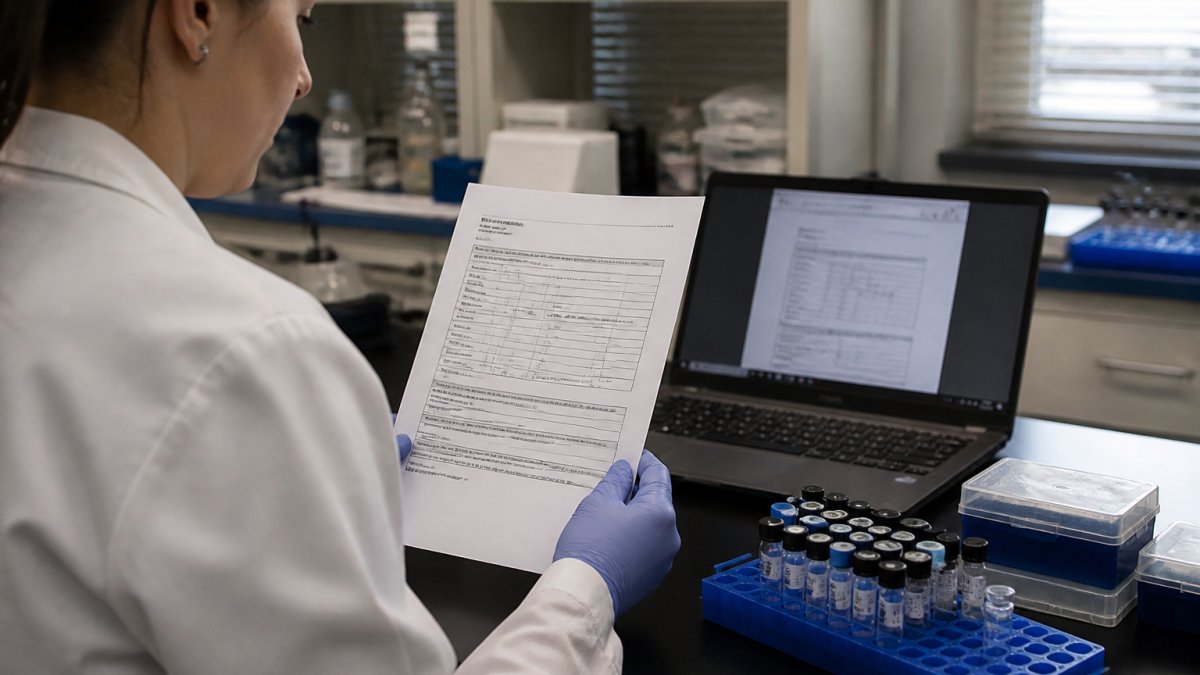
What a Batch Report Should Tell You
Check these fields on every report:
- Product name and lot number matching the vial label exactly
- Identity confirmation, usually by mass spectrometry
- Purity percentage, usually by HPLC, with the method stated
Watch out: a purity figure with no method behind it is decoration, not data. If the report does not name the analytical technique, ask for one that does.
We publish independent batch reports and manufacturer documentation with our products, so you can compare what you ordered against what was tested. For a field-by-field walkthrough, use this guide to reading a certificate of analysis before you approve a batch.
Step 4: Confirm RUO Status and Institutional Compliance Before Ordering
Research-use-only status is a legal boundary, not a label. RUO materials are sold for laboratory research and are not for human or veterinary use. Your compliance office will want that boundary respected in the paperwork.
Before you order, confirm:
- The supplier states RUO status on the product page and the COA
- Your protocol and IACUC or IRB filings match the material's stated use
- Hazard communication and SDS documents are on file
A frequent error is assuming a supplier's RUO language will satisfy your institution. Read the supplier's research-use disclaimer against your compliance office's requirements, then keep a copy with the requisition. Our research-use disclaimer and restrictions are published for exactly this check.
Step 5: Verify Analytical Claims Independently
Trust the report, but confirm the chain behind it: check that the lab named on the COA exists, that the lot number matches, and that the stated method suits the claim.
A practical checklist:
- Search the third-party lab's name and confirm it is a real testing facility
- Match the lot number on the report to the lot number on the vial
- Confirm the test date falls before the ship date
If a supplier cannot produce an independent report for a given lot, treat the claim as unverified. Reviewing available testing reports and COAs before ordering tells you what documentation you will actually receive.
Step 6: Build Laboratory Inventory Management Around Lot Traceability
Laboratory inventory management for peptides lives or dies on lot numbers. When a report is questioned months later, you need to know which vials came from which lot, and where they went.
Set up three habits:
- Log every arrival with product, lot, quantity, and date
- Label storage boxes with lot numbers, not just product names
- Record which experiment used which lot
This matters more for peptides than general consumables: a purity result belongs to a batch, so one lot's result tells you nothing certain about the next. Keeping lots separate protects your data and simplifies later review.
Step 7: Control Receiving, Storage, and Reorder Points
Receiving is where procurement becomes science.
Then set reorder points. Track how long a typical order takes from requisition to delivery, and reorder when remaining stock covers that lead time plus a buffer.
Watch out: ordering against a "usually in stock" assumption is how studies get delayed. Confirm live availability before you submit the requisition, and keep a documentation-qualified backup supplier ready.
Place Your First Peptide Order With Batch Documentation Attached
The gap between a smooth peptide order and a stalled one is almost always documentation, not science.
That is how we built our ordering process at BLACK HAT PEPTIDE COMPANY. Live inventory checks show real availability before you commit.
If you are ready to source with the paperwork in order, follow our step-by-step ordering guide to select products, reserve inventory, pay, and receive tracking.
Frequently Asked Questions
What should a university lab check before ordering research peptides?
Start with four items: the supplier's research-use-only status, a batch-specific certificate of analysis with lot numbers, the manufacturer documentation behind the batch, and whether the vendor can confirm live stock before you commit. Then check your own side: requisition approval, storage location, and who will log the lot on arrival. A supplier that cannot produce batch documentation on request is a procurement risk regardless of price.
What documentation should accompany a research peptide order?
Expect a certificate of analysis tied to the specific lot you receive, analytical testing results covering identity and purity, manufacturer documentation where the supplier is a distributor rather than the producer, and a packing slip that matches the lot numbers on the vials. File all of it against the purchase order. If the lot number on the vial does not match the certificate, quarantine the shipment and query the supplier before use.
How can labs manage peptide inventory and reorder points?
Assign every incoming lot a storage location and log it with the receipt date, quantity, and certificate reference. Set a reorder point based on your actual consumption rate plus the supplier's stated lead time, not a guess. Review the log monthly and flag lots nearing expiry. A simple spreadsheet works for small groups; the discipline of recording lot numbers matters more than the software.
Can research peptides be purchased for laboratory use?
Research peptides sold for laboratory use are labeled research-use-only, which means they are not drugs, dietary supplements, or approved for human or animal consumption. University labs buy them for in vitro and preclinical work under that labeling. Confirm the RUO designation on the product page and the certificate before ordering, and route the purchase through your institution's standard procurement process.
