
Last Updated: November 2, 2026
Quick Summary
Laboratory chemical sourcing means getting the right substance, at the right grade, with trustworthy documentation, before any reaction begins. Evaluate each supplier on a shared checklist, verify the lot-specific certificate of analysis against the container label, and confirm the required safety and research-use documents before ordering.
- Score every prospective supplier against the same six-category checklist, rating each on a 1 to 5 scale.
- Match the lot number on the container, certificate of analysis and packing slip; a mismatch means quarantine.
- Require a lot-specific certificate of analysis that names the analytical method used for purity.
- Compare total cost of ownership, including shipping, minimum order quantities, lead times and storage, not just unit price.
- Confirm the current safety data sheet and research-use terms are available for each chemical before ordering.
Table of Contents
- Building a Chemical Supplier Evaluation Checklist
- Reading and Verifying a Chemical Certificate of Analysis
- Regulatory Requirements and Safety Documentation by Chemical Category
- Step-by-Step Laboratory Supply Ordering Process
- Receiving Shipments and Managing Laboratory Chemical Inventory
- Next Steps: Request Documentation and Check Live Stock With BLACK HAT PEPTIDE COMPANY
- Frequently Asked Questions
Every experiment starts with the materials on your bench, and the chemicals you order are often the least-examined variable. Reliable laboratory chemical sourcing means getting the right substance, at the right grade, with documentation you can trust, before a single reaction begins.
Sourcing errors rarely announce themselves. A lot slightly outside its stated purity can shift a dose-response curve, and a mislabeled vial can invalidate weeks of work.
Building a Chemical Supplier Evaluation Checklist
A chemical supplier evaluation checklist turns vague impressions into comparable, defensible criteria. Most laboratories discover a bad supplier only after a failed run; the checklist moves that discovery to the purchasing stage. Build it once, score every prospective supplier against the same list, and review it annually so decisions hold up during audits, grant reviews, or internal investigations.
A workable checklist covers six categories. Score each supplier on a simple 1-5 scale and keep the completed form with the purchase record.
- Legal identity and facility. Confirm the legal entity behind the storefront, a verifiable physical address, and a responsive contact channel. A supplier that publishes its quality policy, manufacturing location, and testing arrangements is easier to trust than one offering only general assurances.
- Documentation package. Confirm the supplier can provide a lot-specific certificate of analysis (CoA), a safety data sheet (SDS) in the current OSHA Hazard Communication Standard format, and any research-use or restricted-use terms before you order.
- Analytical capability. Ask which methods the supplier uses for identity, purity, and residual solvents, and whether testing is in-house or independent. A CoA naming the technique and its conditions is worth more than a purity figure alone.
- Lot traceability. Confirm that lot numbers on the container, the CoA, and the packing slip link to a manufacturing record. Without that link, a later discrepancy cannot be investigated.
- Lead time and continuity. Record quoted lead times, minimum order quantities, and whether the supplier has a documented backup or allocation policy for critical reagents.
- Commercial terms. Capture price, shipping terms, return and replacement policy, and the process for reporting a nonconforming lot.
Checking Supplier Credibility and Reputation
Supplier credibility rests on verifiable facts, not marketing copy. Ask peers which suppliers have delivered consistent lots over time, and specifically about out-of-specification events and how the supplier responded.
Independent verification is a strong credibility check. Where the material is critical, send a sample to an accredited third-party laboratory for identity and purity confirmation and compare it to the supplier's CoA.
Spotting Counterfeit, Adulterated, or Misrepresented Chemicals
Counterfeit and misrepresented material is a real risk in research supply chains, and it rarely arrives with obvious warning signs. A practical verification workflow catches most problems before the material reaches the bench:
- Verify the manufacturer. Confirm that the manufacturer named on the label actually produces that product and that the supplier is an authorized channel. Contact the manufacturer directly if the relationship is unclear.
- Match lot numbers across documents. The lot on the container, the CoA, and the packing slip should agree. A mismatch is grounds for quarantine until resolved.
- Inspect seals and packaging. Broken seals, missing tamper evidence, handwritten labels, or packaging inconsistent with the manufacturer's standard format are red flags.
Matching Purity and Grade to Intended Use
Not every experiment needs the highest available grade; buying above your requirement wastes budget, and buying below it risks invalid results. Match the grade to the application: exploratory screening may tolerate lower purity than a quantitative assay or a study submitted for regulatory review.
Where a method is sensitive to impurities, such as trace-metal analysis or mass spectrometry, specify the grade explicitly rather than relying on a default.
Comparing Suppliers on Total Cost of Ownership
Price per unit is the least informative number in a supplier comparison. Total cost of ownership adds shipping, minimum order quantities, lead times, storage requirements, and quality-related waste, and it often reverses the ranking unit price alone would produce.
Build a simple comparison sheet for each candidate supplier and record:
- Unit price and minimum order quantity. A lower unit price with a high minimum order can tie up budget and shelf life.
- Shipping and handling. Include flat-rate charges, hazardous-material surcharges, cold-chain packaging, and any free-shipping threshold.
- Lead time and expediting cost. A cheaper supplier with a long lead time may force expedited shipping or a duplicate order to keep a study on schedule.
Reading and Verifying a Chemical Certificate of Analysis
A certificate of analysis, usually abbreviated CoA, is the lot-specific document that reports what was actually measured in the material you received.
Begin by matching the identifiers. The product name, strength or concentration, lot number and sample identifiers on the CoA should match the container label and your purchase record.
Next, examine the test results.
Finally, check whether the CoA is independent or manufacturer-supplied.
The table below summarises the core checks a reader should run on a certificate of analysis.
| Check | What to confirm | Why it matters |
|---|---|---|
| Identifiers | Name, strength, lot number match label | Mismatch means quarantine |
| Test results | Identity and purity with named method | Method adds assurance |
| Source | Independent or manufacturer-supplied | Shapes how much weight to give |
| Availability | Certificate listed before ordering | Avoids post-purchase gaps |
Regulatory Requirements and Safety Documentation by Chemical Category
Regulatory expectations depend on what the chemical is, how it will be used, and who is using it. A sourcing guide that treats compliance as a single checkbox leaves readers unprepared for the category-specific rules that determine whether a shipment can be received, stored, and used. Map each chemical to its category and confirm the required documentation before ordering.
Workplace Safety and Hazard Communication
In the United States, OSHA's Hazard Communication Standard, aligned with the Globally Harmonized System, requires that hazardous workplace chemicals be accompanied by a safety data sheet and labeled containers.
Keep the SDS for every chemical on file where your team can reach it quickly, and review each for storage incompatibilities before the material enters inventory. Confirm the SDS is the current version for the lot and manufacturer, since an outdated sheet can misstate hazard classifications.
Research-Use Terms and Restricted Substances
Research use carries its own restrictions. Review the supplier's research-use terms before ordering and confirm your intended application falls within them. Some materials, controlled substances, select agents, or chemicals under restricted-use frameworks, require permits, registrations, or institutional approvals in place before purchase.
For work feeding into regulated development, ask early whether the documentation meets your sponsor's or review body's quality standards, since retrofitting paperwork afterward is slow and often incomplete.
Transport and Shipping Documentation
Hazardous materials are subject to transport rules covering packaging, labeling, and accompanying paperwork. Before ordering, confirm the supplier ships in compliance with applicable transport requirements, that the package will carry required hazard markings, and that cold-chain material arrives with temperature monitoring. A shipment without correct documentation can be refused or quarantined, and the delay may cost more than the material.
Documentation to Request by Category
Use the following as a starting point when building your order file:
- General laboratory reagents: current SDS, lot-specific CoA, and the supplier's research-use terms.
- Hazardous or corrosive materials: SDS, CoA, transport documentation, and confirmation of compliant packaging.
- Cold-chain or temperature-sensitive materials: SDS, CoA, temperature-monitoring record, and a receiving inspection procedure.
Records, Retention, and Audit Readiness
Compliance is only as good as the records that demonstrate it. Retain SDS versions, CoAs, transport documents, and receiving inspection records for the period your institution, sponsor, or applicable rule requires, and link each record to its lot. A lot-level traceability file connecting purchase order, container label, CoA, and storage location is the single most useful artifact during an audit, and far easier to build at receiving than to reconstruct later.
Step-by-Step Laboratory Supply Ordering Process
A disciplined ordering process reduces both errors and delays. The steps below reflect the workflow most laboratories follow:
- Define the requirement. Record the chemical, grade, quantity, required documentation and the date you need it on the bench.
- Check live availability. Confirm stock before committing to a timeline, since out-of-stock items are a common source of delay.
- Verify the specification. Compare the product's stated purity and format against your protocol before adding it to the cart.
- Complete checkout and payment. Pay promptly so reserved inventory is held for your order.
- Log the order. Record the order number, lot information once assigned, and the expected delivery window in your purchasing system.
Pricing depends on quantity, dates and delivery, so check the BLACK HAT PEPTIDE COMPANY website for current prices or request a quote. You can also learn how checkout, inventory reservation, payment, and tracking work before you place the order.
Receiving Shipments and Managing Laboratory Chemical Inventory
Receiving is the final checkpoint in the sourcing chain. When a package arrives, check the outer packaging for damage, confirm contents against the packing slip, and compare container labels and lot numbers to the CoA.
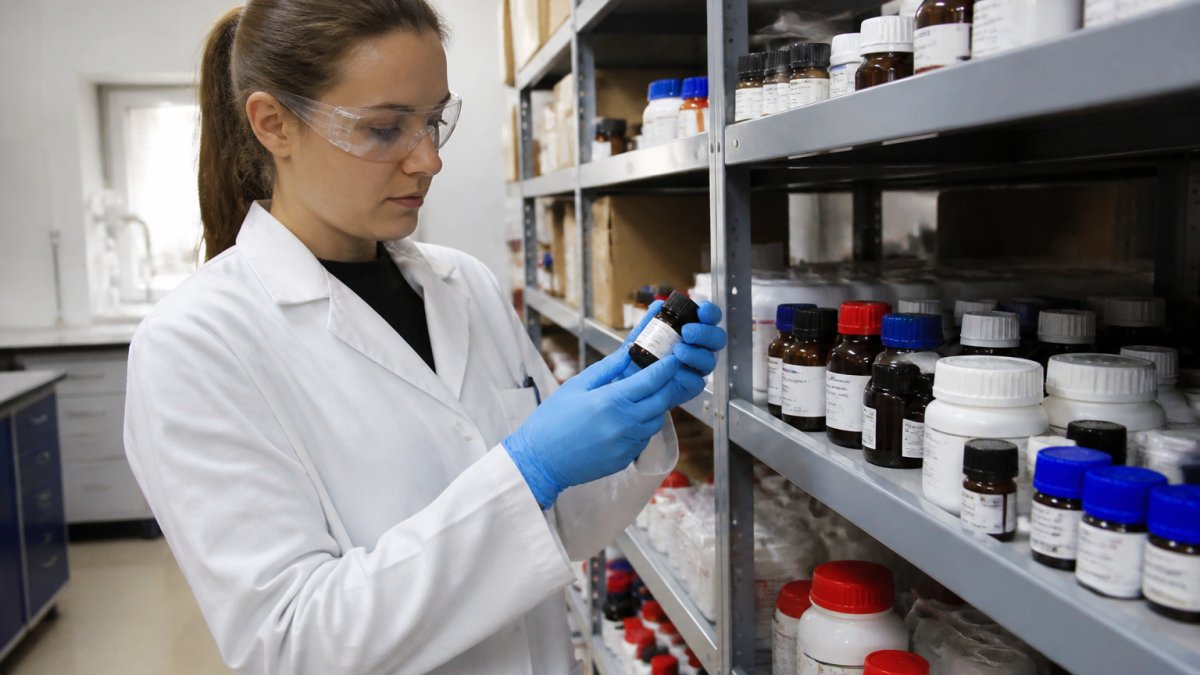
Shipping terms affect what you should plan for. Check the BLACK HAT PEPTIDE COMPANY website for current shipping terms and fulfillment details before ordering.
Once material is accepted, manage it as inventory.
Next Steps: Request Documentation and Check Live Stock With BLACK HAT PEPTIDE COMPANY
Before your next order, pull the CoA and SDS for each material on your list and confirm they match the identifiers you plan to order. Review the research-use terms and restrictions so your intended application is covered. Then check live stock, since availability can change quickly.
Frequently Asked Questions
How do you choose a reliable laboratory chemical supplier?
Start by confirming the supplier provides documentation for every product, including a certificate of analysis, a safety data sheet, and a lot number traceable to the batch. Check how long they have operated, whether they publish clear purity specifications, and whether their technical staff can answer detailed questions about grade and handling. Ask for references from labs with similar research needs. Compare responsiveness during the quote stage, since slow or vague answers often predict problems later. Pricing matters, but it should be weighed against documentation quality, stock accuracy, and delivery reliability, not treated as the deciding factor on its own.
What documents should a chemical supplier provide?
A reliable supplier should provide a certificate of analysis for each lot, showing tested purity and the methods used. A safety data sheet covering hazards, handling, storage, and emergency measures is required for hazardous materials under OSHA's Hazard Communication Standard. Product specifications, the manufacturer or source identity, and lot or batch numbers should also be available. For regulated work, ask whether the supplier can provide quality system documentation and whether independent batch reports exist. Keep these records with your inventory so you can trace any material back to its source if a question arises during an audit or study review.
How can a laboratory verify chemical quality before ordering?
Review the published specifications and confirm the grade matches your application, such as analytical reagent or higher-purity grades for sensitive assays. Read the certificate of analysis for the specific lot you intend to receive, not a generic sample certificate. Compare the listed test methods and results against your accuracy requirements. For critical work, many labs run an in-house identity or purity check on a new supplier's first lot before using it in full studies. Documenting this verification step creates a record that supports data integrity during reviews.
What should a lab check when receiving a chemical shipment?
On arrival, compare the packing list and labels against your purchase order, checking product name, quantity, lot number, and expiration date. Inspect containers for leaks, cracks, or broken seals, and confirm that cold-chain or temperature-sensitive items arrived within their required range. Record any discrepancies immediately and photograph damage before handling the material. Log the lot number, receipt date, and storage location in your inventory system. Reject and report any material that does not match its documentation, and keep the packaging until the issue is resolved.
How can laboratories reduce delays in chemical procurement?
Most delays come from inaccurate inventory records, incomplete purchase requests, or unclear stock status. Keep a current inventory list with minimum stock levels so reorders happen before you run out. Submit requests with complete product names, catalog numbers, grades, and quantities to avoid back-and-forth. Confirm live stock and lead time before committing a project timeline. Establish a single point of contact at the supplier for urgent orders, and build your ordering calendar around the lead times for your most frequently used reagents.
What is the difference between reagent grades?
Reagent grades describe the level of purity and the testing behind it. Technical grade suits general or industrial uses where high purity is not required. Analytical reagent grade material is suited to most quantitative analysis. Higher-purity or specialty grades, such as HPLC or spectroscopic grade, are needed when trace contaminants would interfere with results. Match the grade to your method's required accuracy rather than defaulting to the highest grade, which can add cost without improving outcomes for routine work.
How should laboratories manage chemical inventory and expiration dates?
Assign each container a unique identifier and record its receipt date, opening date, expiration date, and storage location. Use a first-expired, first-out approach so older stock is used before newer lots. Store chemicals by hazard class and compatibility, following the storage requirements in each safety data sheet. Review the inventory on a fixed schedule, removing expired or unusable material through your institution's hazardous waste procedures. Periodic audits catch mismatches between physical stock and records before they cause ordering errors.
How can a lab compare chemical suppliers beyond price?
Look at total cost of ownership, which includes documentation quality, failed or rejected lots, delivery delays, and the staff time spent resolving problems. Compare how each supplier handles stock accuracy, returns, and technical support when a batch does not meet specification. Ask whether minimum order quantities fit your lab's purchasing volume, and whether they can ship hazardous materials compliantly to your location. A supplier with a slightly higher unit price can be the lower-cost choice if it avoids repeated delays and reruns of experiments.
Reliable sourcing is a process you can audit, not a one-time purchase. Request the documentation for your next order, check live inventory on the BLACK HAT PEPTIDE COMPANY site, and build a checklist your whole team can follow. Our team is glad to answer questions about lot documentation and turnaround before you commit to a purchase.
