
Last Updated: November 4, 2026
Quick Summary
The best peptides source alternatives in 2026 are suppliers that prove what is in the vial before the order ships, not just cheaper vendors. Compare them on batch traceability, testing method, documentation source, inventory accuracy, shipping, and payment path rather than price per milligram.
- A research peptide supplier sells compounds labeled for laboratory research only, with batch documentation and purity data per lot.
- A credible CoA shows both HPLC purity results and mass spectrometry identity confirmation on the same lot.
- An in-house report is a manufacturer claim; an independent report carries a third-party lab name and date.
- Match the lot number on the vial against the CoA before storing anything from the shipment.
- Reviews on a supplier's own site are weak evidence on purity; the CoA is what counts.
Table of Contents
- Why Researchers Are Seeking Peptides Source Alternatives in 2026
- Peptide Supplier Comparison: What to Weigh Before You Switch
- The Research Peptide Supplier Checklist Every Lab Should Use
- Reading a Peptide Certificate of Analysis Without Getting Fooled
- Research Peptide Vendor Reviews: How to Read Them Critically
- Storage, Stability, and Drug-Peptide Interactions: The Gaps Most Buyers Miss
- Requesting Batch Documentation From Black Hat Peptide Company
- Frequently Asked Questions
Why Researchers Are Seeking Peptides Source Alternatives in 2026
The best peptides source alternatives in 2026 are not just cheaper vendors. They are suppliers that can prove what is in the vial before the order ships.
The shift is not about price. It is about documentation.
A research peptide supplier is a vendor that sells compounds labeled for laboratory research only, with batch documentation and purity data attached to each lot. That definition is the whole game in 2026.
Below, we show you exactly what to check before you switch, and where most supplier comparisons quietly fall apart.
Peptide Supplier Comparison: What to Weigh Before You Switch
Most comparisons rank suppliers on price per milligram. That is the least useful metric. A cheap vial with no lot traceability costs more in wasted runs and repeated experiments than a documented vial at a higher price. The suppliers worth switching to in 2026 compete on documentation, not discounts.
Here is the framework we would use to compare any two suppliers:
| Criteria | Why It Matters | What to Ask For |
|---|---|---|
| Batch traceability | Ties your sample to a specific lot | Lot number on every vial and CoA |
| Testing method | Shows how purity was measured | HPLC and mass spec results |
| Documentation source | Distinguishes in-house from independent | Lab name and report date |
| Inventory accuracy | Prevents cancelled orders mid-study | Live stock confirmation |
| Shipping and packaging | Protects stability in transit | Discreet packaging, tracking |
| Payment path | Affects procurement speed | Card, ACH, or bank transfer |
Compounding Pharmacies vs. Research Suppliers
These are not interchangeable, and the distinction is the first filter in any comparison. A compounding pharmacy prepares patient-specific prescriptions and is a clinical channel, not a research channel. A research peptide supplier sells compounds labeled for laboratory research only, with batch documentation attached to each lot. If your work is laboratory research, a compounding pharmacy is the wrong procurement path regardless of how strong its documentation looks.
The Testing Methodology Behind a Purity Number
A purity figure means nothing without the method that produced it. Two techniques do most of the work:
- HPLC (high-performance liquid chromatography) separates components in a sample and reports the relative area of the main peak versus impurities. A purity percentage from HPLC is only meaningful when the chromatogram, column type, mobile phase, and detection wavelength are disclosed.
- Mass spectrometry (MS) confirms molecular identity by measuring mass-to-charge ratios. It answers "is this the right molecule?" while HPLC answers "how clean is it?" A CoA that reports purity but no mass confirmation has verified quantity, not identity.
A credible report shows both. Ask whether the lab ran HPLC and MS on the same lot, and whether the report includes the actual chromatogram and spectrum rather than a summary line.
Independent vs. In-House Testing
Independence comes down to who signed the report. An in-house report is a manufacturer claim; an independent report carries a third-party lab name and a date. When you compare suppliers, ask each one to name the testing laboratory and confirm the report format matches that lab's usual output. A supplier that cannot name the lab is asking you to trust a number with no provenance.
Inventory, Shipping, and Payment as Comparison Criteria
These are operational, but they decide whether a study stays on schedule. Live inventory confirmation prevents the cancelled-order problem that stalls a run mid-protocol.
Pricing depends on quantity and product, so confirm current figures directly on the BLACK HAT PEPTIDE COMPANY pricing page or by requesting a quote. Our ordering and shipping FAQ answers the practical questions on payment methods, inventory checks, and shipping terms that most comparisons skip.
Watch out: a supplier that quotes a purity percentage but will not disclose the testing method or the lab name has given you a marketing figure, not a quality claim, treat it as unverified until the documentation arrives.
The Research Peptide Supplier Checklist Every Lab Should Use
Before you place a first order with any supplier, run this checklist. It takes about fifteen minutes and saves weeks of backtracking.
- Confirm the product is labeled for research use only
- Request the CoA for the exact lot you will receive
- Check that the CoA lists a lot number matching the vial
- Verify the testing method is stated, not just a purity figure
- Confirm the testing lab is named
A common mistake is accepting a generic CoA that covers a product line rather than a specific lot. That document tells you nothing about the vial in your hand.
Watch out: if a supplier cannot name the testing laboratory, treat the purity figure as marketing until proven otherwise.
Reading a Peptide Certificate of Analysis Without Getting Fooled
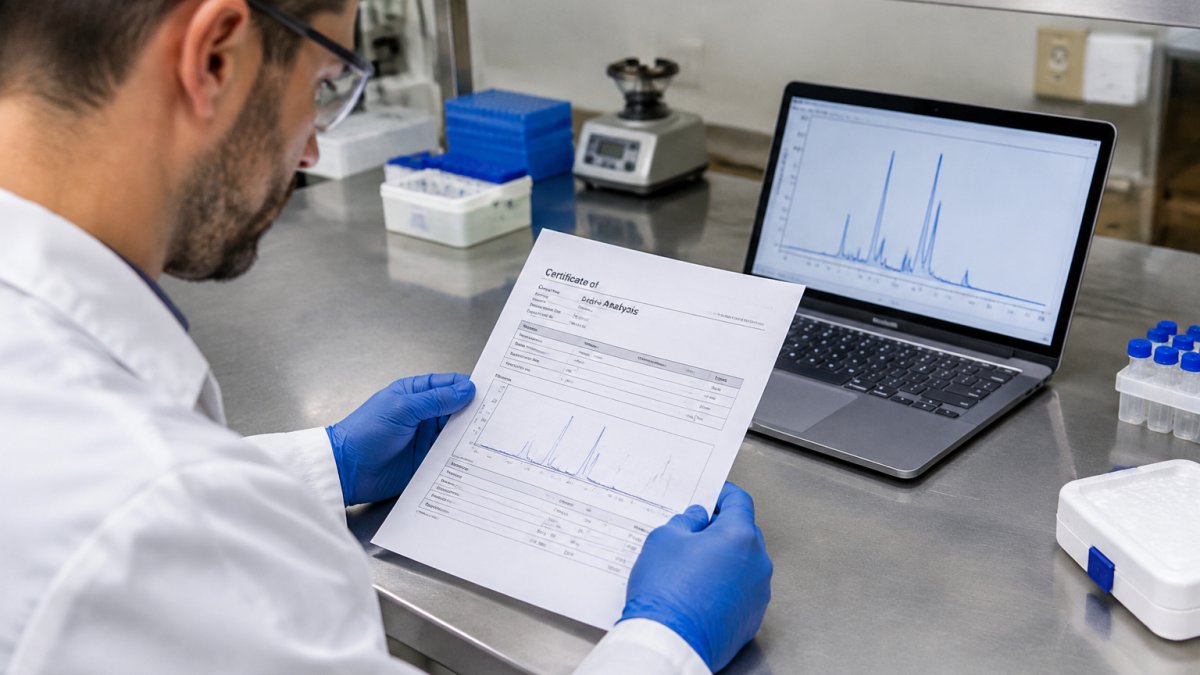
A certificate of analysis is only useful if you can match it to your vial and read what it actually says.
Purity, Mass, and Batch Numbers: What the CoA Should Show
The CoA should state the peptide sequence or molecular formula, the measured mass, the purity percentage with the method used, and a lot or batch identifier. If any of those are missing, the report is incomplete. Our report-matching guide walks through how to compare product name, strength, sample identifiers, identity, purity, and measured content line by line.
How to Read the Chromatogram, Not Just the Percentage
The purity percentage is a summary of a chromatogram, and the chromatogram is where the real information lives. When you look at an HPLC trace, check three things:
- The main peak should dominate the trace. A single sharp peak is the expected pattern for a clean lot.
- Impurity peaks should be small and few. A cluster of shoulders or a broad second peak suggests incomplete synthesis or degradation, even if the headline purity number looks acceptable.
- The baseline should be flat. A drifting baseline can indicate a poorly run method, which undermines the percentage it produced.
A report that shows only a purity figure with no chromatogram is asking you to accept a conclusion without the evidence. Ask for the trace. A supplier that has run the test can produce it.
How to Verify a Batch Report Is Truly Independent
Independence comes down to who signed the report. An in-house report is a manufacturer claim. You can review available independent laboratory reports and manufacturer certificates to see what that documentation looks like in practice.
Verification goes one step further than reading the name. Confirm the report date falls within the lot's production window, confirm the lot number on the report matches the vial, and confirm the sample identifiers on the report match the product you ordered.
Matching the Report to the Vial You Received
When the shipment arrives, do the match before you store anything. Compare the lot number printed on the vial against the lot number on the CoA. Compare the product name and strength against the order.
Watch out: if the lot number on the vial does not appear on the CoA, stop and request the correct report before using the material, a mismatched lot is an unverified sample regardless of how clean the attached report looks.
Research Peptide Vendor Reviews: How to Read Them Critically
Vendor reviews are useful only when you know who wrote them. A review published on a supplier's own site is a testimonial, not an evaluation.
Read reviews with three filters. First, does the reviewer name the product and lot? Second, do they describe a problem and a resolution, or only praise? Third, is the review dated?
Verified customer reviews on a supplier's own page are worth reading for support responsiveness and shipping accuracy. They are weak evidence on purity. For that, you need the CoA.
Storage, Stability, and Drug-Peptide Interactions: The Gaps Most Buyers Miss
Two topics rarely appear in supplier comparisons, and both affect whether your results hold up.
Storage and stability. Lyophilized peptides generally require cool, dry storage away from light, and reconstituted material is typically handled differently from dry powder.
Drug-peptide interactions. If your study combines a peptide with another compound, the interaction is a study design question, not a purchasing one.
Shipping conditions matter here too. Our shipping information covers flat-rate and free domestic shipping thresholds, discreet packaging, and when tracking is issued, all of which affect how product arrives and how quickly you can log it into storage.
Requesting Batch Documentation From Black Hat Peptide Company
At BLACK HAT PEPTIDE COMPANY, we provide independent batch reports and manufacturer documentation with our research products, along with live inventory checks so you know stock status before you pay.
If your principal investigator needs a specific document format, ask before ordering. We would rather answer that question upfront than have a shipment arrive without the paperwork your protocol requires.
Before browsing products or submitting an order, review the research-use disclaimer and restrictions that apply to everything we sell.
Frequently Asked Questions
What are the best alternatives to Peptides Source in 2026?
When comparing peptide suppliers, look for vendors that publish independent batch testing, provide a public certificate of analysis library, and offer transparent pricing. Look for suppliers that show HPLC and LC-MS results per batch, list live inventory, and respond to documentation requests quickly. Compare at least three vendors against the same research peptide supplier checklist before switching, and request a sample CoA from each so you can verify the data matches the batch you would receive.
How can you evaluate a research peptide supplier?
Start with documentation: ask for a peptide certificate of analysis that shows purity percentage, molecular mass, and a batch number tied to the vial you receive. Confirm the testing lab is independent rather than an in-house report. Then check inventory accuracy, shipping terms, and whether the vendor answers technical questions about storage and stability. A peptide supplier comparison should weigh these factors equally, because low pricing means little if the batch documentation cannot be verified or the compound arrives degraded.
What documentation should a research peptide supplier provide?
A reliable supplier should provide a batch-specific certificate of analysis with HPLC purity data, mass spectrometry confirmation, and the testing laboratory's name. Manufacturer documentation and storage recommendations should accompany it. For metabolic or endocrine studies, ask whether GMP-grade documentation is available for the specific compound. If a vendor cannot produce a CoA that matches your vial's batch number, treat that as a red flag regardless of how competitive the price looks.
Are research peptides approved for human use?
No. Research peptides sold for laboratory use are not approved by the FDA for human consumption, and vendors that market them for human use are operating outside the intended research framework. Principal investigators and lab managers should confirm that any supplier frames its products strictly for research purposes, provides appropriate documentation, and does not make therapeutic claims. This distinction matters for regulatory compliance and for the integrity of your study records.
What questions should you ask a peptide supplier before ordering?
Ask four things: whether batch reports come from an independent lab, how live inventory is verified before purchase, what the documentation package includes, and how quickly support responds if a batch fails spec. Also confirm storage and shipping conditions, since peptide half-life and stability depend on cold-chain handling. A straightforward supplier answers these without deflection. Requesting a sample CoA and a written response to your documentation questions takes minutes and reveals how the vendor operates.
Switching suppliers is a documentation decision, not a price decision. If your current vendor cannot produce a lot-specific CoA with a named testing lab, that is the gap worth closing. Get started with BLACK HAT PEPTIDE COMPANY and order with live inventory checks, independent batch reports, and a direct path from order to payment.
