
Last Updated: November 5, 2026
Quick Summary
Research peptide prices vary because listings rarely describe the same product. Differences in peptide length, sequence modifications, purity and its test method, vial size, testing documentation, and shipping terms all change the real cost. Comparing sticker prices alone hides these gaps, so normalize each listing to price per usable milligram.
- Peptide length and sequence modifications add synthesis steps, which raises production cost.
- A purity percentage is only meaningful when the test method and lot-specific COA are known.
- Multiply vial size by purity to estimate usable milligrams before comparing prices.
- Shipping, cold-chain packaging and order minimums can change the total landed cost significantly.
- Compare suppliers only on matching sequences and purity targets, using total landed cost per usable milligram.
Table of Contents
- Why Research Peptide Prices Are So Hard to Compare
- How Synthesis Complexity and Peptide Length Drive Cost
- Peptide Purity and Pricing: What the Percentage Really Means
- Research Peptide Batch Testing and Certificates of Analysis
- Vial Size, Quantity and Price per Milligram
- Hidden Costs: Shipping, Minimums and Total Landed Cost
- How to Evaluate Peptide Suppliers Before Your Next Order
- Building Your Own Research Peptide Price Comparison
- Frequently Asked Questions
Why Research Peptide Prices Are So Hard to Compare
Black Hat Peptide Company LLC sells research peptides, and buyers often ask why one vial of research peptides costs so much more than another. The answer is often less about mystery and more about what a listing leaves out. Two prices can look identical while describing very different products.
The first problem is that listings rarely state the same things. One supplier shows a price per vial, another shows a price per milligram, and a third bundles shipping into the cost. Without normalizing these numbers, a buyer is comparing unlike products.
Here are the most common gaps we see:
- Vial size and fill amount may not be stated clearly
- Purity is often listed without a test method
- Certificates of analysis may be missing or generic
- Shipping and minimums are sometimes hidden until checkout
Understanding these gaps is the first step. The rest of this guide walks through seven reasons research peptide prices vary so much, and how to account for each one.
How Synthesis Complexity and Peptide Length Drive Cost
Longer peptides are harder to make. Each added amino acid is another coupling step, and each step can lose a little yield and purity. That is why a short peptide and a long chain rarely cost the same.
Synthesis complexity also rises with modifications. Changes to the sequence, such as altered residues or added side groups, require extra steps and extra analytical work. A modified sequence is not a cosmetic variant of a standard one. Its production and testing costs can be meaningfully higher.
When comparing prices, check:
- The number of amino acids in the sequence
- Whether the sequence is standard or modified
- Whether the listing reflects the same sequence you need
Watch out: two listings with the same peptide name can describe different sequences or salt forms. Confirm the sequence before comparing prices.
Peptide Purity and Pricing: What the Percentage Really Means
A purity figure, such as 98% or 99%, tells you the share of the target peptide measured against the other material in the sample. The remainder can include related fragments, residual solvents or salts. Higher purity usually requires more purification steps, which raises cost.
A purity percentage is only meaningful if you know the method behind it. Two suppliers can both report 98% and mean different things. Ask which analytical method produced the number and whether it was run on the specific lot you will receive.
Research peptide buyers should also look for the mass confirmation alongside purity. A chromatogram shows relative purity, while mass data confirms the molecule is the one listed.
Research Peptide Batch Testing and Certificates of Analysis
A certificate of analysis, or COA, is the document that links a lot number to measured results. It is one of the most useful tools a buyer has, and one of the most often misread.
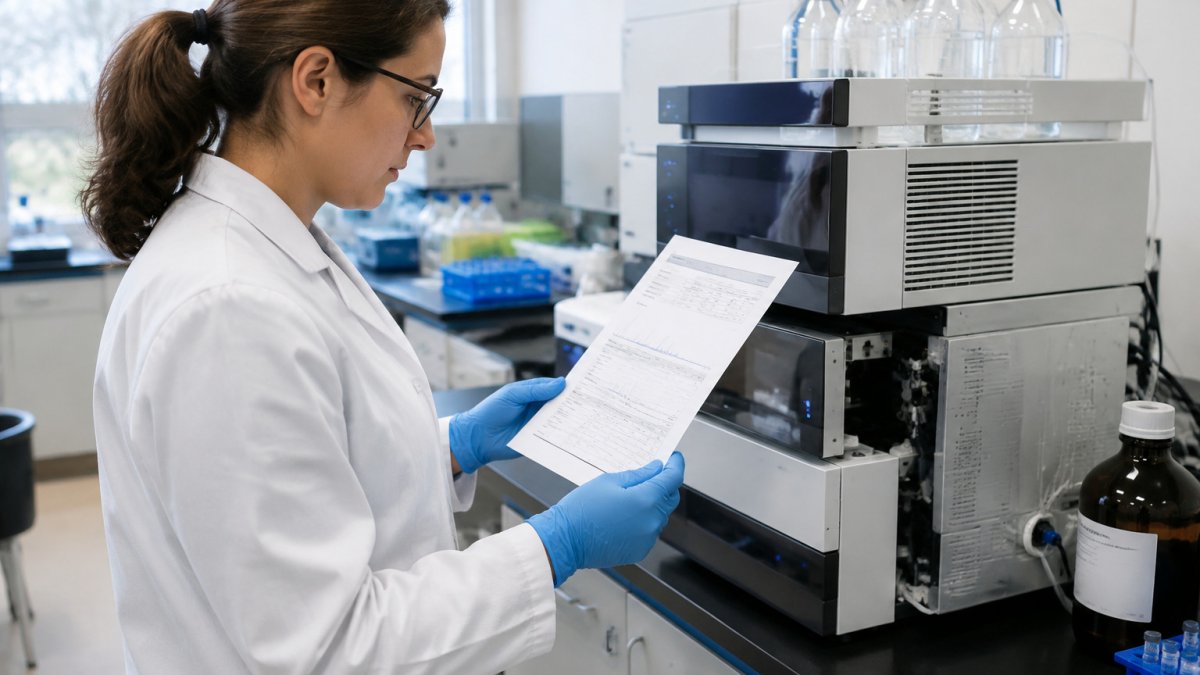
Independent batch testing matters because it checks claims made by the manufacturer. A COA from an unaffiliated laboratory carries more weight than a summary a supplier writes about its own product. Black Hat Peptide Company LLC offers independent batch reports and manufacturer documentation, so buyers can review the documents themselves. View available independent laboratory reports and certificates of analysis for selected products.
When you review a COA, check:
- Product name and strength match your order
- Lot or batch number matches the vial you receive
- Identity, purity and measured content are all reported
- The testing laboratory and date are listed
FDA guidance on analytical method validation for drug substances
Learn to read the report line by line. A supplier that makes testing documentation easy to find is usually easier to verify.
Vial Size, Quantity and Price per Milligram
A vial price means little until you divide it by the usable amount. Two vials priced the same can hold very different quantities, so the cheaper-looking one may cost more per milligram. The problem is that most listings stop at the sticker price, and most buyers stop at a simple division.
Quantity breaks also change the math. Some suppliers reduce the unit price for larger orders. Others charge a flat rate regardless of quantity. Neither model is automatically better; it depends on how much you need and how fast you use it. A bulk discount only helps if you can use the full quantity before degradation or expiry becomes a concern.
A Step-by-Step Method for Normalizing Prices
Use this method to compare listings fairly. It goes beyond a simple price-per-milligram division by folding in purity, testing, and fees so the final number reflects what you actually get.
- Record the listed price and the stated vial size in milligrams. If the fill amount is not stated, treat that as a red flag and ask the supplier before comparing.
- Divide the price by the milligram amount to get a raw price per milligram.
- Adjust for purity. If one vial is 95% pure and another is 99%, the usable target peptide differs. Multiply the vial size by the purity percentage to estimate usable milligrams, then divide the price by that adjusted figure. A 10 mg vial at 95% purity yields about 9.5 mg of target peptide; the same vial at 99% yields about 9.9 mg.
- Add any shipping charge and divide by the same adjusted milligram amount. Shipping is a fixed cost that hits small orders hardest.
- Account for order minimums. If a supplier requires a $150 minimum and you only need $60 of product, the effective cost per milligram rises because you are buying more than you need.
- Confirm the purity figure and test method for each listing. A purity number without a method is not comparable.
- Compare the normalized numbers only between products with matching sequences and purity targets.
A worked example makes the gap visible. A $120 vial of 10 mg at 99% purity costs $12.00 per raw milligram, or about $12.12 per usable milligram. A $90 vial of 5 mg at 95% purity costs $18.00 per raw milligram, or about $18.95 per usable milligram.
| Step | What to record | Why it matters |
|---|---|---|
| 1 | Listed price and vial size (mg) | Starting cost and usable amount |
| 2 | Raw price per mg | Baseline comparison |
| 3 | Purity-adjusted usable mg | Reflects actual target peptide |
| 4 | Shipping added | Captures fixed costs |
| 5 | Order minimum impact | Reveals forced overbuying |
| 6 | Purity and test method | Confirms quality match |
| 7 | Sequence match | Ensures like-for-like comparison |
Watch out: a low price per milligram on a small vial can disappear once shipping and minimums are applied. Always run the full method before declaring a winner.
This normalization approach is the part most price guides skip.
Hidden Costs: Shipping, Minimums and Total Landed Cost
The advertised price is rarely the final price. Shipping, order minimums, handling fees, payment processing, and cold-chain requirements all affect what you actually pay.
Packaging is discreet, and this business offers discreet fulfillment. Shipping terms are available on the website at the time of order. Review the full shipping information, including packaging and tracking, before you check out.
To estimate landed cost, build a simple worksheet with these line items:
- Product subtotal for your intended quantity
- Shipping charge, including any cold-chain or insulated packaging fee
- Order minimum shortfall, if you must buy more than you need to meet a threshold
- Payment processing fee, if the supplier passes card or wire fees to the buyer
- Sales tax or other applicable charges
- Any handling or documentation fee
Add the line items, then divide by usable milligrams using the purity-adjusted method above.
A worked example: a $180 order that adds $20 shipping totals $200, which qualifies for free shipping under the threshold, so the shipping charge drops out at that point.
Cold-chain handling deserves separate attention. Ask whether the shipping quote includes cold-chain materials, and confirm that the packaging is appropriate for the product's stability requirements. Browse research supplies to see which items can ship with your products in the same order.
Watch out: a supplier that advertises free shipping may recover the cost through a higher product price or a minimum order threshold. Compare landed cost, not the shipping line alone.
Ask every supplier for the full shipping, minimum, and fee policy before you compare totals.
How to Evaluate Peptide Suppliers Before Your Next Order
Price is only one factor. A supplier should also show you how it handles inventory, documentation and support.
Look for these signals:
- Live inventory checks, so an order is not delayed by stock errors
- Independent batch reports and manufacturer documentation for each lot
- A clear ordering and payment path
- Responsive customer support you can reach when a problem occurs
- Transparent shipping and availability information
Black Hat Sublevel is the public-facing research brand of Black Hat Peptide Company LLC. Its site covers research-use products and the ordering process, so you can check those details before you buy. Learn about who operates the brand and how orders are fulfilled.
Remember that research peptides are for laboratory research use. Make sure your purchase, handling and storage follow your institution's policies and applicable regulations.
Building Your Own Research Peptide Price Comparison
A personal comparison sheet keeps you from relying on any single listing. Track the same fields for every supplier you consider:
- Supplier and product name
- Sequence and any modifications
- Vial size in milligrams
- Listed price and shipping
- Price per milligram and total landed cost
- Purity, test method and COA availability
- Lot number and testing date
Update the sheet each time you order.
Start with the testing documents for the product you need, then run the numbers. Visit the BLACKHATPEPCO website for current product information and available testing documentation to begin your own comparison.
Frequently Asked Questions
Why do research peptide prices differ so much? Prices differ because of peptide length, sequence modifications, purity targets, testing depth, vial size and shipping terms.
What does a purity percentage tell me? It shows the share of the target peptide measured by a stated method. Confirm the test method and check the lot-specific certificate of analysis.
How do I compare prices fairly? Divide each listed price by its milligram amount, add shipping, and compare only products with matching sequences and purity.
Frequently Asked Questions
Why are research peptide prices so different between suppliers?
Most of the gap comes from factors that are easy to overlook on a product page: the purity level actually tested, the synthesis method and sequence length, how much independent batch testing a supplier pays for, and the vial size or minimum order. A low per-vial price can hide a lower usable amount or a lower purity grade. Compare suppliers on price per milligram of verified material, with a current certificate of analysis for the specific batch, before deciding the difference is real.
Does peptide purity affect the price?
Yes. Higher purity usually requires more purification steps, such as additional preparative HPLC runs, and more analytical testing to confirm the result. Those steps consume solvent, time and instrument capacity, which raises production cost. A higher purity percentage is only worth paying for if your study design needs it, and the number should be confirmed by a batch-specific HPLC chromatogram rather than a generic claim.
Are low-priced research peptides always lower quality?
Not always, but a low price deserves verification. A supplier may have lower overhead, buy in volume, or sell a smaller-scale product. The risk is that corners are cut on purification or testing. Check whether the batch has a dated certificate of analysis with HPLC purity and mass spectrometry identity data, and whether the supplier will provide it on request before you commit.
How can I compare peptide prices per milligram?
Divide the total vial price by the stated net peptide content in milligrams, not the gross weight. Then adjust for purity, so a vial priced at a lower per-milligram rate but with lower verified purity may not be the better value. Add shipping, minimum order charges and any handling fees to get the total landed cost. Record the figures and the date of each quote so the comparison can be repeated later.
