
Table of Contents
- What GMP Grade Peptide Certification Actually Means
- GMP vs Research Grade Peptides: What Changes in Practice
- How to Verify GMP Compliance Before You Order
- The GMP Peptide Certificate of Analysis: What It Proves and What It Doesn't
- Peptide Batch Documentation: Records, Traceability, and Batch Consistency
- Is GMP Grade Peptide Certification Required for Research Use?
- Conclusion: Making a Confident Sourcing Decision
- Frequently Asked Questions
Last Updated: October 12, 2026
What GMP Grade Peptide Certification Actually Means
What is GMP grade peptide certification? It is a claim that a peptide was made under Good Manufacturing Practice rules, not a single certificate you can hang on a wall.
That distinction matters: a vendor can print "GMP certified" on a label without any regulator ever inspecting the site.
Good Manufacturing Practice (GMP) governs how drugs and drug ingredients are made, tested, and documented.
GMP, cGMP, and the FDA's Role in Peptide Manufacturing
Current Good Manufacturing Practice (cGMP) is the FDA's working standard, "current" means the rules track today's technology and expectations, not a fixed 1970s rulebook.
The FDA sets cGMP requirements through FDA guidance on current Good Manufacturing Practice and inspects registered facilities against them. For peptides made for research only, those rules generally do not apply.
Here is the practical split:
- Pharmaceutical-grade peptides must be made under cGMP at an inspected facility.
- Research-use-only (RUO) peptides are sold for lab work, not human use, and sit outside that framework.
- "GMP grade" is often a marketing phrase with no legal definition for RUO products.
That third point is where most sourcing mistakes start.
GMP vs Research Grade Peptides: What Changes in Practice
The real difference between GMP and research grade peptides is documentation and control, not the molecule. The same sequence can be made under either standard; what changes is how tightly the process is controlled and recorded.
Under GMP, every step is defined before production starts: equipment qualified, processes validated, staff trained and logged. Research grade material skips most of that overhead, which keeps costs down and makes RUO peptides affordable for academic labs.
But you give up something real:
- Batch-to-batch consistency is harder to prove
- Traceability stops at the supplier's door
- Contaminant testing may be minimal or absent
Neither grade is "better" in the abstract. The right choice depends on what the material is for.
| Feature | GMP Grade | Research Grade (RUO) |
|---|---|---|
| Intended use | Human/clinical | Laboratory research |
| FDA oversight | Yes, facility inspections | Generally no |
| Batch records | Full, retained | Often limited |
| Process validation | Required | Rare |
| Traceability | Complete chain | Partial |
| Relative cost | Higher | Lower |
How to Verify GMP Compliance Before You Order
Verification is where buyers have the most power and use it the least.
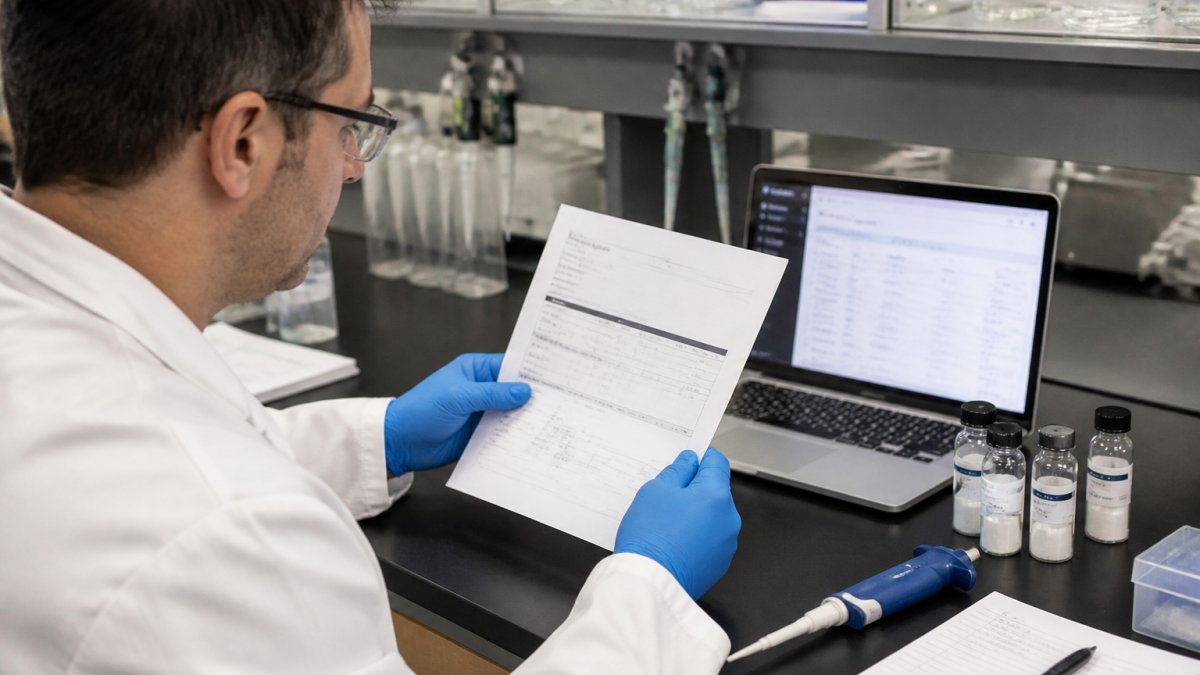
Ask the supplier directly for their facility's registration status and inspection history. A legitimate GMP operation can point to real records; a reseller who never touches the manufacturing site usually cannot.
What Inspection Records Actually Show
An FDA inspection is not a pass/fail stamp. Inspectors issue public Form 483 observations for conditions that may violate cGMP. A clean history is not proof of perfection, but repeated 483s for the same issue, incomplete batch records, failed stability testing, are a real signal.
Ask the supplier:
- Which legal entity owns the manufacturing site, and is that entity registered with the FDA?
- When was the last inspection, and what was the outcome?
- Were any Form 483 observations issued, and how were they resolved?
A supplier who cannot answer these questions may not be fraudulent, but they are not giving you the evidence to make a sourcing decision.
Reading the Quality System, Not Just the Product
GMP compliance lives in the quality management system (QMS), not a single product test. Ask for evidence of the system itself:
- Quality manual or QMS overview, the framework that governs how the site operates
- Standard operating procedures (SOPs) for production, testing, and release
- Training records showing staff are qualified for their roles
You do not need to audit every document, just confirm they exist, are current, and reference the same site, equipment, and personnel across the packet. Inconsistencies (a CoA from one lab, a batch record from another, a QMS manual with no revision date) are the tell.
The Verification Checklist
Run this before you place a first order:
- Request the facility's FDA registration and last inspection outcome
- Ask for a sample certificate of analysis (CoA) for the exact lot you will receive
- Confirm the CoA lists test methods, not just results
If a supplier dodges any of these, that is your answer.
A Decision Process for Buyers and Researchers
Match the evidence to the intended use:
- Basic bench research, non-clinical, a lot-specific CoA with identity and purity methods is the minimum.
- Research feeding into a regulatory pathway, you need full GMP documentation: batch records, validation reports, and a QMS that will survive review.
- Human-use or clinical material, the facility must be registered and inspected, and the documentation must be complete from raw material to release.
If a supplier cannot tell you which category their product fits, they have not thought about it either, and you absorb that risk, not them.
The GMP Peptide Certificate of Analysis: What It Proves and What It Doesn't
A GMP peptide certificate of analysis proves what was found in the sample tested, not that the whole batch is clean, and not GMP compliance. Conflating those claims is the most common error in peptide sourcing.
A CoA is a batch-level test report; GMP compliance is a facility- and system-level status. A clean CoA can come from a facility with no quality system, and a strong quality system can still produce a failing lot, the difference is that they catch it and do not ship it.
How to Read the Results, Not Just the Headlines
Most CoAs lead with a purity percentage, which is only meaningful if you know the method behind it.
- Purity by HPLC, High-performance liquid chromatography separates the peptide from related impurities. A purity figure of 98% by area means 98% of the UV signal at a given wavelength came from the main peak. It does not mean 98% of the mass is your peptide. Method details matter: column type, gradient, wavelength, and whether the peak was integrated manually or automatically.
- Identity by mass spectrometry, Mass spec confirms the molecular weight matches the expected sequence. It does not confirm the sequence itself. Two peptides with the same mass can have different arrangements of the same amino acids. For sequence confirmation, you need tandem mass spec (MS/MS) or Edman degradation, which most CoAs do not include.
- Potency or content, For peptides with known biological activity, a potency assay (often cell-based or binding-based) tells you whether the material actually works. A purity figure says nothing about potency. A peptide can be 99% pure by HPLC and still be biologically inactive if it aggregated or degraded.
What a CoA Cannot Tell You
Even a well-documented CoA has limits:
- Whether the facility actually follows cGMP
- Whether the sample tested matches the vial in your hand
- Whether other lots from the same run are equally clean
- Whether the peptide will remain stable under your storage conditions
That last point is underappreciated: a method validated for one peptide is not automatically valid for another. If the CoA does not state the method was validated for your material, the results are indicative, not definitive.
What a Solid CoA Should Include
- Purity by HPLC, with the method stated
- Identity by mass spectrometry, with the expected and observed mass
- Potency or content where relevant to the intended use
- Contaminant testing for residuals, heavy metals, and microbial limits
Batch COA vs. GMP Compliance Evidence
A batch CoA is a snapshot of one lot; GMP compliance evidence is a pattern across many lots, backed by a quality system. To judge whether a supplier is genuinely GMP-compliant, the CoA is the starting point, not the destination.
Ask for:
- CoAs from multiple lots over time, to see consistency
- Batch records that show how the lot was produced
- Deviation reports that show how out-of-spec results were handled
- Stability data that shows the material holds up over its shelf life
A supplier who can only produce a single CoA is selling a test result, not a quality system, not the same product, price, or trust.
Peptide Batch Documentation: Records, Traceability, and Batch Consistency
Peptide batch documentation is the paper trail connecting raw materials to finished vials. Without it, batch consistency is a promise rather than a fact. Good records let you trace a single vial back through production, raw material sources, equipment used, process parameters, and test results.
The core documents include:
- Batch records showing what was done and by whom
- Standard operating procedures (SOPs) that define each step
- Deviation reports when something went off-plan
- Corrective and preventive action (CAPA) records that close the loop
Traceability separates a controlled process from a hopeful one: if a batch fails, records tell you why; if a study needs defending, records back you up.
Is GMP Grade Peptide Certification Required for Research Use?
No. GMP certification is not required for research-use-only peptides in most lab settings, RUO material is sold for bench work, not human use, so cGMP generally does not apply. But "not required" is not the same as "not worth checking."
Even for basic research, you want:
- A CoA that matches your lot
- Identity and purity testing you can review
- A supplier who answers questions about their process
Where GMP documentation becomes essential is when your work feeds into a clinical or regulatory pathway. At that point, RUO paperwork will not carry you through review.
Conclusion: Making a Confident Sourcing Decision
The hard part of sourcing peptides is not finding a supplier. It is knowing whether their quality claims hold up. What is GMP grade peptide certification?
At BLACK HAT PEPTIDE COMPANY, we provide independent batch reports and manufacturer documentation, run live inventory checks so your order reflects real stock, and keep pricing transparent with no reseller markup.
Get started with BLACK HAT PEPTIDE COMPANY and source your next peptide with documentation you can actually check.
Frequently Asked Questions
Is there an official GMP certification for peptides?
No. The FDA does not issue a 'GMP certificate' for peptide manufacturers. GMP is a set of regulatory requirements a facility must comply with. Some third-party auditors offer voluntary certification programs, but these are not FDA-issued credentials. When a supplier claims 'GMP certified,' ask which auditor issued the certification and whether the FDA has inspected the facility. A genuine compliance record includes inspection history, not just a certificate.
What is the difference between GMP and cGMP?
GMP stands for Good Manufacturing Practice. The 'c' in cGMP means 'current,' signaling that requirements evolve with technology and industry standards. In practice, the FDA enforces cGMP, so the terms are often used interchangeably. For peptide manufacturing, cGMP means the facility must stay current with updated methods for process validation, equipment qualification, and documentation. A supplier citing 'GMP' from a decade-old audit may not meet today's cGMP expectations.
Does a certificate of analysis guarantee peptide purity?
No. A certificate of analysis (COA) reports results from specific tests, typically HPLC purity and mass spectrometry identity confirmation. It does not guarantee the sample was handled correctly after testing, nor does it cover contaminants outside the tested panel. A COA from an unaccredited lab carries less weight than one from an independent, accredited facility. Pair the COA with batch documentation and supplier audit history for a fuller picture.
Are GMP grade peptides approved for human use?
Not automatically. GMP compliance means a facility meets manufacturing quality standards, but it does not mean a specific peptide has FDA approval for human use. FDA approval requires clinical trials and a separate drug application. Research peptides, even those made under GMP conditions, are typically labeled for research use only. If a supplier implies their GMP grade peptides are approved for human consumption, that is a red flag.