
Table of Contents
- What You'll Need Before Verifying a Peptide Batch Report
- Step 1: Match the Batch Number to Your Vial and Packaging
- Step 2: Identify the Issuing Laboratory and Verify Independence
- Step 3: How to Verify a Peptide COA with Laboratory Contact
- Step 4: Interpreting Peptide HPLC Purity Reports
- Step 5: Check Analysis Dates, Report Identifiers, and Revisions
- Common Red Flags and What to Do If Something Doesn't Match
- Frequently Asked Questions
Last Updated: October 21, 2026
What You'll Need Before Verifying a Peptide Batch Report
Before you start learning how to verify independent peptide batch reports, gather a few essentials. You'll need the physical vial and its packaging. You'll also need the batch report itself.
The process sounds complicated, but it follows a straightforward checklist. You're matching three things: the batch number on your vial, the laboratory that tested it, and the actual test results.
Have these items ready:
- The peptide vial with its label intact
- Original packaging or documentation
- The certificate of analysis (CoA) or batch report
- Laboratory contact information if you need to verify directly
- A method to safely contact the testing laboratory
The verification process takes about 15 minutes once you know what to check. Start with the batch number. Everything else flows from there.
Step 1: Match the Batch Number to Your Vial and Packaging
The batch number is your anchor point. Everything else connects to it. Find the batch number on your vial's label.
These numbers must match perfectly. No variations. No close approximations.
Check these locations:
- Vial label (usually printed clearly)
- Original packaging box or container
- Certificate of analysis header section
- Batch report document identifier
A common mistake is assuming similar numbers are close enough. They're not. If the numbers don't match exactly, stop and contact the supplier immediately.
Once the batch numbers align, you've confirmed you're looking at the right report for the right product. This single step prevents most verification errors.
Step 2: Identify the Issuing Laboratory and Verify Independence
Now identify who actually ran the tests.
The critical question: Is this an independent third-party laboratory, or did the supplier test their own product in-house?
Independent testing means a separate organization conducted the analysis.
Check for these independence indicators:
- Laboratory name differs from the supplier's company name
- Separate physical address listed
- Direct contact phone number and email provided
- Laboratory accreditation or certification mentioned
- Report identifier unique to the testing facility
In-house testing by the supplier is not inherently bad, but it's different from independent verification.
BLACK HAT PEPTIDE COMPANY uses independent third-party laboratories specifically because researchers need that external verification.
If you're unsure whether a laboratory is truly independent, move to the next step and contact them directly.
Step 3: How to Verify a Peptide COA with Laboratory Contact
This step separates thorough verification from surface-level checking, and it is central to how to verify independent peptide batch reports. Contact the laboratory directly and confirm the report exists.
Find the laboratory's contact information on the batch report. Call or email them. Keep your message simple and professional.
A legitimate independent laboratory will confirm or deny the report quickly. They maintain records. They can look up the report by batch number or report identifier.
What to ask when you contact the laboratory:
- "Is this report number authentic and issued by your facility?"
- "Can you confirm the analysis date and what was tested?"
- "Are the results shown in this document the official results from your laboratory?"
- "What analytical methods did you use for this batch?"
Expect a straightforward answer. Professional laboratories respond to these inquiries regularly.
Document the confirmation. Write down the date you called, who you spoke with, and what they confirmed. This creates a paper trail if questions arise later.
Step 4: Interpreting Peptide HPLC Purity Reports
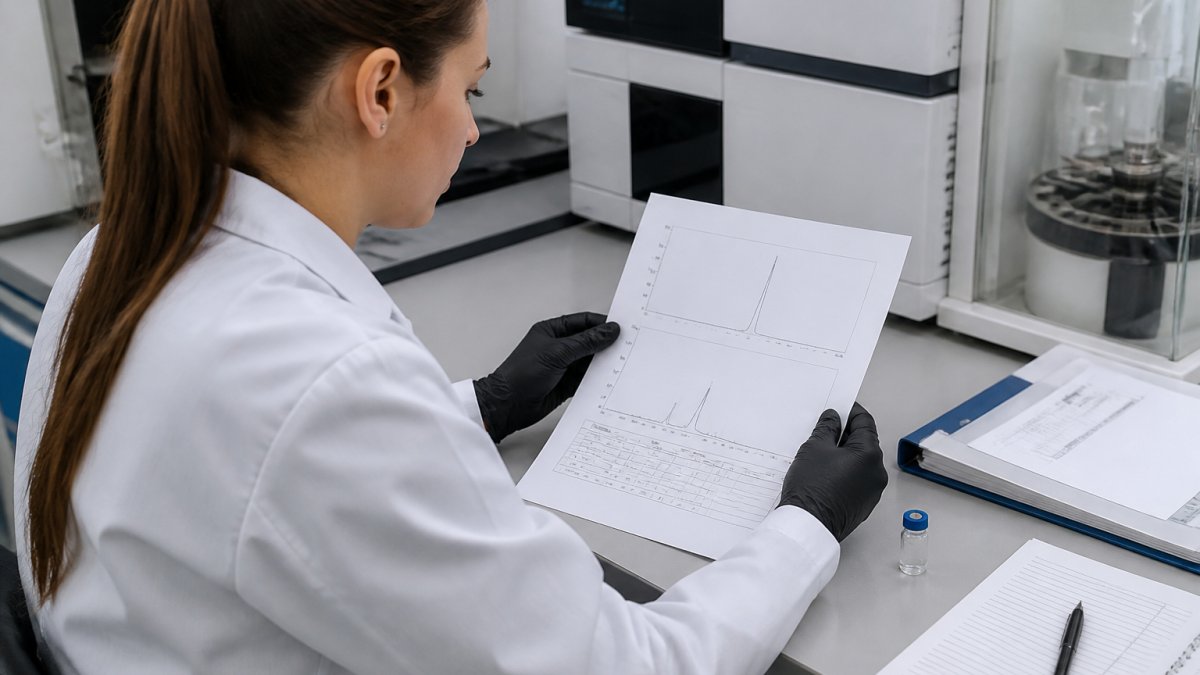
HPLC stands for high-performance liquid chromatography. It is the standard method for measuring peptide purity, and the report it produces is the single most useful piece of evidence in a batch report, if you know how to read it. A stated "98% pure" means little on its own.
Read the chromatogram, not just the percentage
A chromatogram is a graph with time on the horizontal axis and detector response on the vertical axis. Each peak represents a compound that eluted from the column. The largest peak should be your target peptide; smaller peaks are impurities, byproducts, or residual solvents and salts. The purity percentage is calculated by dividing the area of the target peak by the total area of all integrated peaks.
When you look at the chromatogram, check these elements:
- Peak shape. A sharp, symmetrical peak suggests a clean single compound. A broad, shouldered, or split peak can indicate co-eluting impurities, degradation, or a poorly run method.
- Baseline. A flat, stable baseline is a sign of a well-run analysis. A drifting or noisy baseline makes integration unreliable and can inflate or deflate the reported purity.
- Number of peaks. A report showing one dominant peak and a handful of small impurity peaks is typical for research-grade material. A chromatogram with many comparable peaks deserves an explanation.
- Integration marks. Most reports show the integration lines that define each peak's area. If the integration is not visible, ask the laboratory for the raw data file or a version that shows it.
Retention time and why it matters
Retention time is the time at which your peptide's peak appears. It is a fingerprint of sorts: under the same method and column, the same peptide should elute at the same retention time. If you have a report for an earlier batch of the same peptide, compare retention times. A significant shift suggests a different compound, a different method, or a problem with the analysis.
Confirm identity with mass spectrometry
Purity tells you how much of the sample is one thing; it does not tell you what that thing is. Mass spectrometry (often LC-MS) provides the identity check. The report should list the observed mass-to-charge ratio (m/z) and the calculated molecular weight of the expected peptide. For a credible report, the observed mass should match the calculated mass within the instrument's expected tolerance. If the report shows only a purity percentage and no mass confirmation, you have purity without identity, a meaningful gap.
Understand what HPLC does and does not establish
HPLC measures what is in the sample at the moment of testing. It does not measure stability over time, sterility, endotoxin content, residual solvents unless those tests are explicitly included, or biological activity. A high purity percentage is not a guarantee of safety or suitability for any particular use. Treat the report as evidence of chemical purity and identity, and look for separate tests if those other attributes matter to your work.
If the purity percentage seems unusually high (for example, above 99.5%) or unusually low (below 90%), ask the laboratory to explain. Extreme values are not automatically wrong, but they warrant a conversation about the method, the integration, and the sample.
Step 5: Check Analysis Dates, Report Identifiers, and Revisions
Dates matter. The analysis date tells you when the test was performed.
Look for these date fields:
- Analysis date (when the sample was tested)
- Report issue date (when the report was completed)
- Report revision number (if applicable)
- Expiration date or validity period (if stated)
Old reports are problematic. If the analysis date is more than six months old, the peptide may have degraded or changed.
Check the report identifier. This is a unique number assigned by the laboratory.
If you see a revision number, that means the report was updated after initial issue. Ask why. Sometimes revisions correct minor errors.
These details seem minor, but they establish the report's authenticity and relevance.
Common Red Flags and What to Do If Something Doesn't Match
Mismatches happen. Sometimes they are simple clerical errors; sometimes they indicate a real problem. The difference between a minor error and a serious concern is usually found in how you respond. This section gives you a decision path rather than a list of warnings.
Red flags that require immediate attention
- Batch numbers do not match between the vial and the report
- Laboratory contact information is incomplete, generic, or unreachable
- The report has no date, or the analysis date is more than a year old
- Purity percentage is missing, implausible, or inconsistent with the chromatogram
- The report identifier cannot be confirmed by the laboratory
- Multiple revisions appear without explanation
- HPLC data is incomplete or lacks key information such as retention time or integration
- The laboratory name is the same as the supplier's company name with no independent testing noted
- The mass-spectrometry result is missing or does not match the expected peptide
A step-by-step response when something does not match
- Pause use of the batch. Do not continue using material from a batch with an unresolved discrepancy. The cost of waiting is almost always lower than the cost of acting on bad information.
- Preserve the evidence. Keep the vial, its label, the original packaging, and the batch report exactly as received. Do not relabel, discard, or alter anything. Photograph the vial label and the report side by side so the batch numbers are visible in one frame.
- Contact the supplier first, in writing. Ask a specific question: "The batch number on my vial reads X, but the report shows Y. Can you explain the difference?" Written communication creates a record and gives the supplier a chance to correct a clerical error.
- Contact the laboratory directly if the supplier cannot resolve it. Use contact details you source independently, from the laboratory's own website or a public directory, rather than only the details printed on the report. Ask them to confirm the report identifier, batch number, and analysis date.
- Escalate if the laboratory denies issuing the report or cannot locate it. At that point you are dealing with a potentially fabricated or altered document. Stop use of the batch, retain all materials and correspondence, and consider reporting the concern to the appropriate state or federal consumer-protection or health authority.
Document everything
Keep a simple record of what did not match, when you discovered it, who you contacted and when, what explanation you received, and what action you took. This record protects you if questions arise later about batch integrity or testing accuracy, and it makes any escalation far easier to support.
When to walk away
Not every discrepancy is recoverable. If the batch number cannot be reconciled, the laboratory will not confirm the report, or the supplier cannot provide a credible explanation after a reasonable follow-up, treat the batch as unverified. An unverified batch is not the same as a bad batch, but it is a batch you cannot rely on, and that is the standard that matters for research work.
Frequently Asked Questions
How do I check a peptide batch number?
Locate the batch number on the vial label and packaging. Cross-reference it with the batch number printed on the certificate of analysis (CoA). The numbers must match exactly. If you received multiple vials from the same order, each vial should have the same batch number. If the numbers don't align, contact your supplier immediately before using the product.
How can you tell if a peptide COA is real?
Verify the issuing laboratory's contact information and confirm it is independent (not owned by the supplier). Check that the report includes a unique report identifier, analysis date, and issue date. Call the laboratory directly using a phone number from their official website to confirm they issued the report. Authentic reports contain detailed HPLC and mass spectrometry data with retention times and purity percentages, not just generic statements.
What do HPLC purity results tell you about a peptide?
HPLC (high-performance liquid chromatography) measures the percentage of your target peptide versus impurities in the sample. The chromatogram shows peaks: the tallest peak represents your peptide, and smaller peaks represent contaminants. A purity report lists the percentage area under the main peak. Higher purity percentages (typically 95%+) indicate fewer impurities. The retention time and analytical method used should match the validated method for your specific peptide sequence.
Does a third-party test report prove that a peptide is authentic?
A third-party report from an independent laboratory confirms that the batch was tested and provides composition data, but it does not establish absolute authenticity on its own. The report verifies purity, identity (via mass spectrometry), and absence of tested contaminants. To confirm authenticity, you must verify the laboratory is truly independent, match the batch number to your vial, and confirm the report matches the product you received. A real independent report combined with batch traceability provides strong evidence of quality.