
Last Updated: November 14, 2026
Quick Summary
You can find independent batch reports on a supplier's product page, usually as a linked PDF or documentation tab, and in testing or quality pages, footer links, or account dashboards. A report only counts if its batch or lot number matches the vial you received and it names the testing laboratory.
- Start with the product page, not the homepage, when hunting for batch documentation.
- A certificate with no batch number, lab name, or test date is decoration, not documentation.
- A complete certificate should list product name, batch identifier, test method, purity, and lab name.
- HPLC reports purity as a percentage, while mass spectrometry confirms the peptide's identity.
- If a supplier cannot produce a report for your lot, treat that as your answer.
Table of Contents
- What Independent Batch Reports Actually Are
- Where to Find Independent Batch Reports on a Supplier Site
- How to Verify a Peptide COA Before You Order
- What a Peptide Certificate of Analysis Should Contain
- Third-Party Peptide Testing: What Independence Really Means
- Peptide Purity Testing Methods and How to Read the Results
- Troubleshooting Missing, Expired, or Incomplete Reports
- Requesting Batch Documentation With Your Order
- Frequently Asked Questions
What Independent Batch Reports Actually Are
Independent batch reports are testing documents produced by a laboratory that has no financial stake in the product being sold. That last part matters more than most buyers realize.
A batch report ties a specific production lot to measured results: identity, purity, and often sterility or heavy metals.
A certificate generated in-house does not carry the same weight as one produced by an outside laboratory.
So where do you actually find these documents? That is what this guide covers. Below, we walk through supplier sites, COA matching, verification steps, and what to do when a report goes missing.
Where to Find Independent Batch Reports on a Supplier Site
Start with the product page, not the homepage. Most suppliers host batch documentation next to the listing itself, usually as a linked PDF or a small "documentation" tab.
If nothing appears there, check these spots in order:
- A dedicated testing or quality page in the main menu
- Footer links labeled "COAs," "Lab Results," or "Documentation"
- The product listing's image gallery, where certificates are sometimes uploaded as photos
- A search bar query using the batch number or product name
Watch out: a "certificate" graphic with no batch number, no lab name, and no test date is decoration, not documentation. Skip it.
Navigation Paths and Terminology That Vary by Platform
Different platforms label the same thing differently. A Shopify store might bury reports under "Resources." A custom-built site might call them "Certificates of Testing" or "Analytical Reports."
Search these terms when the obvious links fail:
- COA or certificate of analysis
- Batch report, lot report, or testing documentation
- Purity report or analytical results
On larger sites, the Reports menu may sit inside an account dashboard rather than the public storefront. If you have an account, log in and look for a report tab or working area near your order history.
Matching a Batch Report to the Vial You Received
A report only counts if it matches your specific lot. Compare these identifiers side by side:
- Product name and strength
- Batch or lot number on the vial label
- Sample identifiers on the report
- Test date against the manufacturing date
If the lot numbers do not match, the report belongs to a different production run. Ask for the correct one. Our report matching walkthrough explains how to compare each field line by line.
How to Verify a Peptide COA Before You Order
Verification starts before money changes hands, and it is more than a glance at the layout. A certificate can look official and still be incomplete, out of date, or tied to a different lot. The checks below separate a real batch report from a marketing sheet.
Check the Report's Scope and Source Data
Start with scope. A batch report should state which batch it covers, how many samples were drawn, and whether the results apply to the entire lot or only a sample. A report that lists results without a batch identifier cannot be tied to your material.
Next, check the source data. A complete report names the testing laboratory, the method used, and the date the analysis was performed. HPLC and mass spectrometry are standard for peptides; a report listing no method is incomplete.
Verify Independence and Completeness
Independence has degrees, and the document should let you judge which degree applies. Ask three questions of any certificate you find.
First, who performed the test? A named laboratory with contact details is a good sign. A blank lab field is not.
Second, is the report separated from other batches? A report that aggregates multiple lots into one result sheet cannot confirm your specific batch. Look for a single batch identifier per report, or a table that clearly separates results by lot.
Third, are timestamps and identifiers consistent? The report date, batch number, product name, and sample identifiers should all agree.
Access, Privacy, and Auditability
Readers often overlook who can view or download a report and how access is recorded. In a public storefront, reports may be downloadable by anyone, which is convenient but offers no audit trail. In an account dashboard or quality system, downloads may be logged with user, timestamp, and report version. If you need documentation for a research protocol or institutional file, ask whether the supplier can provide a download record or a signed report copy. A supplier that treats documentation as an afterthought will treat it that way after the sale too.
Troubleshooting a Missing or Unavailable Report
Sometimes the report is not there, or the link fails. Before you assume the worst, work through these fixes:
- Search the batch number directly in the site search bar or system search.
- Check whether the report sits behind an account login or a permission level your account does not have.
- Confirm the date range filter is not excluding the report.
- Look for a "download report" or "export report" button on the product or batch page.
- Check whether a report job is still processing or has failed.
- Email support with your batch number and order details.
- Request the report for your specific lot if only a sample lot is posted.
Watch out: an expired report is a different problem. Testing from two years ago may not reflect the current batch. Ask for a current one, and keep the reply on file.
A common mistake is trusting a COA because it looks official. Layout means nothing. Identifiers, lab attribution, and scope mean everything.
What a Peptide Certificate of Analysis Should Contain
A complete peptide certificate of analysis should list the product name, batch identifier, test method, measured purity, and the testing laboratory's name. Missing any one of those fields weakens the document.
Here is the full checklist we suggest:
- Product name and stated strength
- Unique batch or lot number
- Manufacturing or production date
- Test method used (HPLC, mass spectrometry, or both)
- Measured purity result
- Appearance or physical description
- Storage and handling notes
- Laboratory name and report date
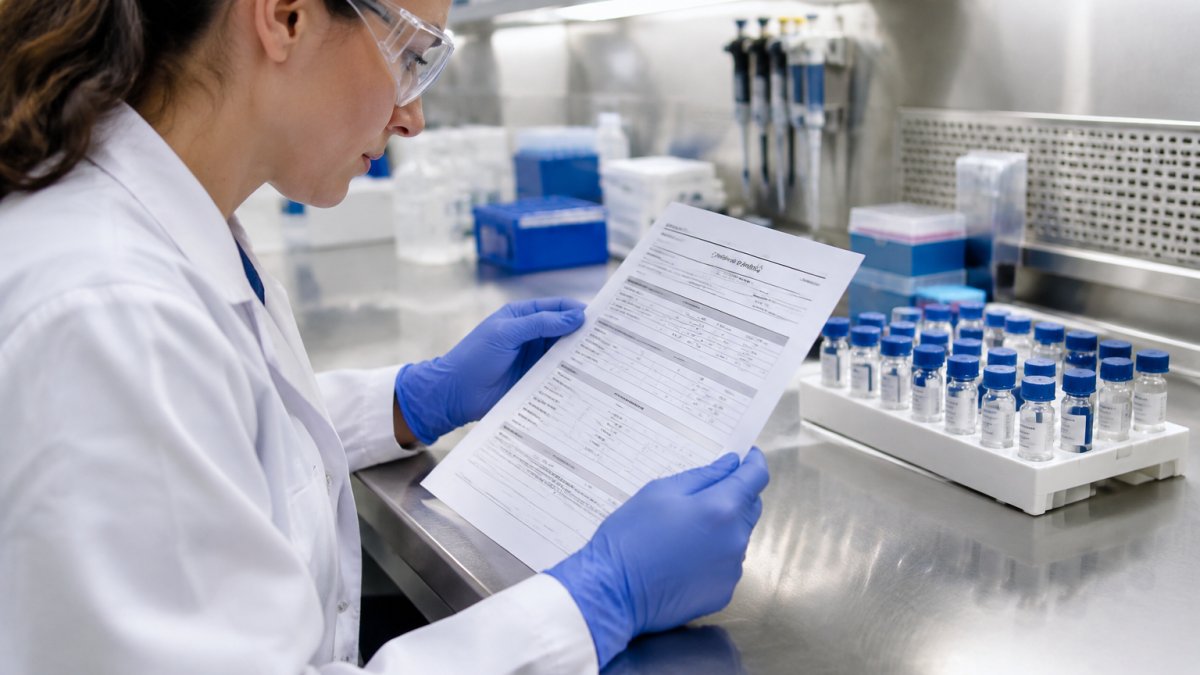
If a supplier's certificate stops at "purity: high," you have a marketing sheet, not an analysis.
A complete certificate of analysis should carry every one of these fields.
| Field | What it shows |
|---|---|
| Product name and strength | Identifies the material and dose |
| Batch or lot number | Ties the report to one production run |
| Manufacturing date | Compared against the test date |
| Test method | HPLC, mass spectrometry, or both |
| Measured purity | Stated result with method named beside it |
| Appearance | Physical description of the sample |
| Storage and handling | Notes for keeping the material |
| Laboratory name and report date | Who tested it and when |
Third-Party Peptide Testing: What Independence Really Means
Third-party peptide testing means a laboratory outside the supplier's organization performed the analysis. Independence is the entire value proposition.
But independence has degrees. A lab paid per sample by the supplier is still external, though the relationship is commercial. A lab with no relationship to the supplier at all is stronger still.
Ask suppliers directly: which lab runs your tests, and can you share its contact information? A straightforward answer is a good signal. A vague one tells you something too.
At Black Hat Peptide Company, independent batch reports and manufacturer documentation ship alongside our research products. You can view the available testing reports and certificates on our site.
Peptide Purity Testing Methods and How to Read the Results
Two methods dominate peptide testing, and each answers a different question.
HPLC separates compounds in a sample and reports purity as a percentage of the main peak. It tells you how much of the material is the target peptide.
Mass spectrometry measures molecular weight (Mass Spectrometer). It confirms the peptide's identity, meaning the compound is actually what the label claims.
Most complete reports include both. When you read the results, look for a stated purity figure with the method named beside it.
Also check for a chromatogram or spectrum image. Many reports include the raw output. Its presence suggests real testing occurred.
Troubleshooting Missing, Expired, or Incomplete Reports
Sometimes the report simply is not there. Before you assume the worst, work through these fixes:
- Search the batch number directly in the site search bar
- Check whether the report sits behind an account login
- Look for a "download report" or "export report" button on the product page
- Email support with your batch number and order details
- Request the report for your specific lot if only a sample lot is posted
An expired report is a different problem. Testing from two years ago may not reflect the current batch. Ask for a current one.
If a supplier cannot produce a report for the lot you received, treat that as your answer. No document, no purchase.
Requesting Batch Documentation With Your Order
The simplest way to guarantee documentation is to ask for it up front. Add a note to your order requesting the batch report for your lot, or send a message before checkout.
What to include in your request:
- Product name and quantity
- Order number or intended order date
- The specific documentation you need (COA, batch report, or both)
- Any institutional requirements, such as documentation for a research protocol
Our team handles documentation requests directly. You can contact us with questions about products, orders, or batch documentation, and we will confirm what is available for your lot before fulfillment.
Ask early, and keep the reply on file.
Finding independent batch reports is really a test of the supplier, not your search skills.
Black Hat Peptide Company offers independent batch reports and manufacturer documentation alongside its research products, along with live inventory checks and direct payment processing.
Frequently Asked Questions
Where can I find a peptide batch report?
Ask the supplier directly, then confirm it matches your order. A legitimate independent batch report is tied to a specific lot number printed on the vial label, not a generic sample report reused across products. On supplier sites, look for a documentation or quality section, or a link on the individual product page. If a supplier cannot produce a lot-specific report on request, treat that as a signal about how much verification actually sits behind the product.
How can I tell whether a peptide report is independent?
Check who performed the testing. An independent batch report names a laboratory that is not owned by or affiliated with the supplier, and it carries that lab's own report format, method references, and results. In-house documentation usually appears on the supplier's own letterhead with no external lab identity. Look for the testing facility's name, a report or sample identifier, the analytical methods used, and dated results you could ask the lab to confirm.
What is the difference between a manufacturer certificate of analysis and independent testing?
A manufacturer certificate of analysis is issued by the party that made the material, so it reflects their own quality checks. Independent testing is performed by a separate laboratory with no stake in the sale. Both are useful, but only the second one gives you verification you did not have to take on trust. For research where purity affects your conclusions, ask for the independent report and keep the manufacturer documentation alongside it.
What should I do if a supplier cannot provide a batch report?
Ask once in writing, specifying the lot number and the testing you need. If the answer is vague, refers only to a generic sample, or never arrives, source elsewhere. Batch reports are a normal part of supplying research chemicals, and a supplier that cannot produce one for the specific lot you received leaves you unable to verify purity, identity, or handling. Document the request either way so your lab records show what was and was not provided.
