
Last Updated: November 1, 2026
Quick Summary
Effective peptide storage starts with the vial label: confirm whether the material is lyophilized or in solution, and match the setpoint to the manufacturer's guidance for that lot. Store lyophilized powder at -20°C, move to -80°C for long-term use, and aliquot reconstituted solution to avoid freeze-thaw cycles.
- GenScript recommends storing lyophilized peptides at -20°C, away from bright light and under dry conditions.
- Sigma-Aldrich distinguishes short-term storage of one to two weeks at -20°C from longer-term storage at -80°C.
- Refrigeration at 2°C to 8°C suits brief holding periods and working stocks drawn from within days.
- Reconstitute once, divide immediately, and thaw only what you need for a single use.
- Let a cold vial equilibrate to room temperature before opening so condensation forms outside, not inside.
Table of Contents
- Why Peptide Storage Decisions Start With the Vial Label
- Peptide Storage Temperature: Matching the Setpoint to the Form
- Peptide Storage in Solution: What Changes After Reconstitution
- Peptide Aliquoting Best Practices for Single-Use Handling
- Peptide Stability and Shelf Life: Reading the Evidence Honestly
- Moisture, Light, and Vial Handling in the Storage Container
- Cold-Chain Monitoring, Excursion Response, and Audit-Ready Records
- Sourcing Peptides With Documentation That Supports Your Storage SOP
- Frequently Asked Questions
Why Peptide Storage Decisions Start With the Vial Label
Best practices for peptide storage lab work begin before anything touches a freezer: they begin with the vial label.
Labs often treat storage as a housekeeping task and only discover the gap when a batch underperforms. The label is your first control point, and it should answer three questions immediately.
- Is the material lyophilized (freeze-dried powder) or already in solution?
- What does the manufacturer state about identity, purity, and recommended handling?
- Which lot number ties this vial to its documentation?
A common mistake is assuming all vials sharing a product name share handling requirements. They do not.
Peptide Storage Temperature: Matching the Setpoint to the Form
Peptide storage temperature is not one number. It is a decision that follows from the peptide's form, your intended use window, the solvent or buffer it sits in, and the manufacturer's stated guidance for that specific lot.
Published handling guidance from suppliers converges on a practical split. GenScript's peptide storage and handling guidelines recommend storing lyophilized peptides at -20°C, away from bright light and under dry conditions.
What those summaries leave out is why the setpoint changes. Three variables drive the decision:
- Form. A lyophilized powder has no free water to support hydrolysis or most solution-phase degradation, so it tolerates warmer setpoints for longer. A reconstituted solution is already in the reaction environment, and stability shortens accordingly.
- Sequence and composition. Sequence composition can affect stability, so confirm storage conditions against the manufacturer's guidance for the specific peptide.
- Solvent and buffer. The manufacturer's recommended solvent is part of the storage specification, not an optional suggestion.
Refrigeration Versus Freezer: Short-Term and Long-Term Setpoints
Refrigeration at 2°C to 8°C suits brief holding periods and working stocks you will draw from within days. Freezer storage at -20°C is a common setpoint for lyophilized material, subject to the manufacturer's stated guidance. Move to -80°C when the manufacturer specifies it or when your use window extends well beyond the label's stated stability timeline.
| Form | Short-Term Setpoint | Long-Term Setpoint | Key Risk |
|---|---|---|---|
| Lyophilized powder | -20°C | -20°C to -80°C | Moisture ingress |
| Reconstituted solution | 2°C to 8°C | -20°C to -80°C in aliquots | Freeze-thaw damage |
| Working stock in use | 2°C to 8°C | Not applicable | Repeated warming |
Thermal Cycling and the Freeze-Thaw Cycle
Every freeze-thaw cycle is a stress event. Ice crystal formation and re-dissolution can drive aggregation and loss of activity, which is why supplier guidance explicitly warns against repeated freeze-thaw cycles. Avoid repeated warming as a matter of routine, not just when something looks off.
Decide at reconstitution how many uses you need, split accordingly, and never return a thawed aliquot to the freezer.
Choosing and Qualifying the Storage Unit
Equipment selection is part of the temperature decision, not an afterthought. Verify with a calibrated logger that the storage interior stays within your acceptable band under normal load.
Temperature mapping matters as much as the setpoint. Shelves near the door, the top, and the evaporator run warmer or colder than the center, so place a calibrated probe in the warmest and coldest locations you identify and record the mapping in your SOP.
Peptide Storage in Solution: What Changes After Reconstitution
Peptide storage in solution is a different problem from powder storage. Once reconstituted, the peptide sits in a solvent at a defined concentration, and stability generally shortens. Use reconstituted material within the timeframe your manufacturer's stated shelf life specifies.
Dissolve gently, following the manufacturer's reconstitution instructions.
Solvent, Concentration, and Agitation
Solvent choice affects both solubility and stability. Manufacturer guidance usually names the recommended solvent, and substituting a different one without documentation is a common mistake that undermines later comparisons. Record concentration at reconstitution, label the vial with date and concentration, and store upright to keep the solution off the closure.
Peptide Aliquoting Best Practices for Single-Use Handling
Peptide aliquoting best practices come down to one principle: reconstitute once, divide immediately, and thaw only what you need for a single use. This removes the freeze-thaw cycle from routine handling entirely.
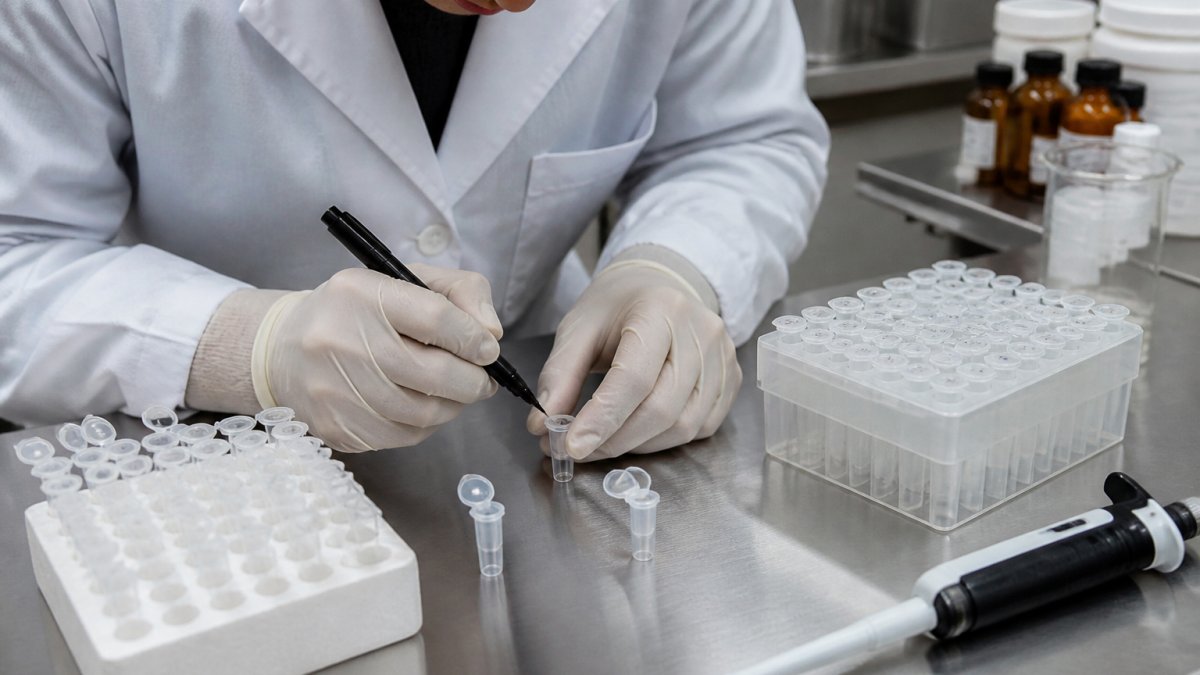
Work in sizes that match your assay volume. You can browse research supplies such as vials and lab consumables to order alongside your products.
Aseptic Handling and Contamination Control
Contamination control is where storage quality and technique meet. Work in a clean, draft-free area, use sterile consumables, and keep a dedicated set of pipettes for peptide work. NIBSC's peptide handling, dissolution and storage guidance emphasizes dry, cool, dark storage conditions alongside careful dissolution practice.
Reusing a needle or pipette tip across vials risks cross-contamination, which may not surface until later in an assay.
Peptide Stability and Shelf Life: Reading the Evidence Honestly
Peptide stability and shelf life claims deserve more skepticism than most labs apply. A stated shelf life is a manufacturer's judgment based on specific conditions, not a guarantee that holds under your handling.
Read the COA properly: match product name, strength, lot identifier, and measured content to the vial in hand, and check what was actually tested versus what was merely specified. Our guide to reading the report and matching the lot walks through each field.
Where the evidence is thin, say so in your records. "Stable per manufacturer guidance at -20°C" is a defensible entry; "stable indefinitely" is not.
Moisture, Light, and Vial Handling in the Storage Container
Moisture protection and light protection are the two environmental controls most often skipped. Moisture can accelerate degradation, so protect lyophilized powder from ambient humidity. Let a cold vial equilibrate to room temperature before opening it, so condensation forms on the outside rather than inside.
Keep vials in a sealed secondary container with desiccant, and store them in the dark. Amber vials or an opaque box both work.
If packaging and arrival conditions are part of your SOP, our shipping information covers how orders are packed and tracked.
Cold-Chain Monitoring, Excursion Response, and Audit-Ready Records
Temperature monitoring turns storage from an assumption into a record. A calibrated data logger in each storage unit, with a documented review cadence, is the baseline. What separates an audit-ready program from a logger taped to a shelf is the surrounding procedure: calibration, alarm thresholds, backup power, and a written excursion response.
Monitoring Equipment and Calibration
Use a continuous data logger with a documented calibration interval, per the manufacturer's specification, and keep the calibration certificate with the unit's records. A common pattern is one logger per storage unit, with the probe placed in the warmest mapped location rather than on the door. Logging interval is a trade-off: a short interval captures brief excursions but generates more data to review, while a long interval can miss a door-open event entirely.
Alarm Thresholds and Backup Power
Set alarm thresholds around your acceptable band, not at the setpoint itself. If your SOP accepts -20°C ± 5°C, the alarm should trigger at the edge of that band so you have time to respond before material is out of specification.
Backup power is an important part of the storage plan. A freezer on a circuit that also feeds a centrifuge can lose power to a tripped breaker, and a unit on a generator-backed circuit survives an outage that takes down the rest of the lab.
Excursion Response
When a temperature excursion occurs, the response matters more than the alarm. A workable sequence:
- Record the peak temperature, the duration, and the material affected, with the logger export attached to the record.
- Quarantine the affected vials rather than returning them to service on assumption.
- Assess stability against the manufacturer's stated conditions and your own use window before release.
- Document the disposition decision, including a decision to discard.
Audit-Ready Records and Inventory
Audit-ready records mean receiving records, storage documentation, and labeling all trace to the same lot number. A practical record set includes:
- Receiving record with lot, form, quantity, and arrival condition
- COA filed against the lot
- Storage location and setpoint at time of placement
Inventory rotation is an important control point. First-in, first-out keeps older lots from sitting past their stated stability window, and a periodic review of on-hand material against the COA's stated shelf life catches expired or unknown-age vials before they enter an assay. Where the evidence is thin, say so in your records: "Stable per manufacturer guidance at -20°C" is a defensible entry; "stable indefinitely" is not.
Sourcing Peptides With Documentation That Supports Your Storage SOP
Documentation is the part of storage that survives an audit. A storage SOP is only as strong as the paperwork behind each vial: receiving record, COA, and labeling that agree with one another.
Batch reports and manufacturer documentation are available for selected products, so the lot on your shelf can be matched to the data in your binder. You can view available testing reports and COAs for selected research products. Review the research-use disclaimer before finalizing SOP language.
Frequently Asked Questions
How should peptides be stored in a laboratory?
Store lyophilized peptide as a freeze-dried powder in a sealed vial at -20°C, and move to -80°C for longer-term storage. Keep the vial upright, dry, and protected from light. Once you reconstitute, divide the peptide solution into single-use aliquots and freeze them so you thaw only what one experiment needs. Label every vial with the peptide name, lot, concentration, solvent, and date, and record the storage location so anyone in the lab can find it.
What temperature is best for storing research peptides?
The right peptide storage temperature depends on form and horizon. Published handling guides place lyophilized peptide at -20°C for routine work and at -80°C when you need longer-term storage. Reconstituted peptide solution is less stable and should be frozen in aliquots, thawed once, and used within the timeframe your manufacturer guidance states, often within 30 days. Some peptides tolerate 2°C to 8°C for short-term use, but confirm that against your own stability evidence rather than assuming it.
Should peptides be stored as a powder or in solution?
Powder first, solution only when you are ready to use it. A lyophilized peptide in a sealed vial is far more tolerant of shipping and bench time than a peptide solution, which is exposed to hydrolysis and microbial risk once reconstituted. If a protocol forces you to keep working solution, aliquot it immediately and freeze the surplus. Reconstituting the whole vial and leaving it at room temperature for days is the most common way labs lose material to avoidable degradation.
How can repeated freeze-thaw cycles affect peptide stability?
Each freeze-thaw cycle concentrates the peptide as ice forms, and that can drive aggregation and adsorption to the vial wall. The damage compounds: five cycles is not the same as one. Single-use aliquoting removes the problem because each tube is thawed once and discarded. If you must reuse a tube, thaw on ice, keep it cold, and avoid repeated warming.
How should peptides be aliquoted for laboratory use?
Reconstitute once, then divide immediately under aseptic conditions. Work in a clean area, use sterile technique, and pipette volumes that match a single experiment so nothing is left over. Label each tube before freezing with peptide name, lot number, concentration, solvent, date, and your initials. Freeze flat and store upright. Record the aliquot count in your inventory so you know how many freeze-thaw exposures remain available and when to reorder.
How do you protect peptides from moisture and light?
Keep vials sealed and let them equilibrate to room temperature before opening, so condensation does not form on cold powder. Store with desiccant in a dry cabinet or sealed container, and never leave a vial open on the bench. For light, use amber vials or wrap tubes in foil and keep the storage container closed. Bright light drives oxidation of susceptible residues, and moisture invites hydrolysis, so both protections belong in your written SOP rather than in individual habits.
What information should be included on a peptide storage label?
A usable label carries peptide name and sequence identifier, lot or batch number, mass or concentration, solvent used, reconstitution date, storage temperature, and the initials of whoever prepared it. Add the expiry or review date your stability timeline supports. Labels matter for audit-ready records: a reviewer should be able to trace a vial back to its receiving record and batch documentation without asking anyone. Print labels rather than handwriting when you can, since marker fades in freezers.
How long can peptides be stored in a laboratory?
There is no single answer because stability depends on sequence, form, and conditions. Stability depends on sequence, form, and conditions. Use the manufacturer guidance on the batch documentation as your starting point, then confirm with your own stability checks if the peptide is critical to an assay. Treat any shelf life figure as an evidence-qualified estimate, not a guarantee, and document the basis for the date you set.
Storage failures rarely announce themselves. They surface months later as an assay that will not reproduce, and by then the trail is cold. Build the record at intake, hold the setpoint, and buy from a supplier whose documentation you can actually file. Get started with BLACK HAT PEPTIDE COMPANY and give every vial a paper trail that holds up.
