
Last Updated: October 23, 2026
Quick Summary
The best peptide suppliers for metabolic research prioritize transparency, independent batch testing, and reliable logistics over catalog size alone. BLACK HAT PEPTIDE COMPANY, Phoenix Pharmaceuticals, and Biosynth Peptides each serve different research needs, with BLACK HAT PEPTIDE COMPANY offering live inventory verification and batch-specific independent CoAs without reseller markup.
- GMP-grade peptides cost 2-3x more than research-grade but meet pharmaceutical standards; know which your protocol requires before ordering.
- Every batch must include a batch-matched certificate of analysis from an independent laboratory with HPLC chromatogram, LC-MS identity confirmation, and test date.
- Live inventory checks prevent backorder delays; verify stock exists before payment rather than discovering delays after purchase.
- Store peptides at -20°C for months or -80°C for years; room-temperature storage degrades most peptides within weeks.
- Compare per-milligram costs directly between suppliers to identify reseller markups, which can significantly inflate prices.
Table of Contents
- How to Choose the Best Peptide Suppliers for Metabolic Research
- Research Peptide Supplier Comparison: What Sets Them Apart
- BLACK HAT PEPTIDE COMPANY: Direct Supply, Transparent Pricing, Independent Documentation
- Phoenix Pharmaceuticals: ISO 9001-Certified Peptide Manufacturer
- Biosynth Peptides: Custom Synthesis and Multi-Source Expertise
- Understanding Peptide Supplier Certificate of Analysis and Testing
- Peptide Purity Testing: What Your Lab Should Require
- Peptide Storage and Handling: Maintaining Integrity After Delivery
- Frequently Asked Questions
How to Choose the Best Peptide Suppliers for Metabolic Research
Selecting the right best peptide suppliers for metabolic research determines whether your lab can trust its data. Poor supplier choice leads to contaminated batches, delayed timelines, and wasted grant funding.
The core difference isn't catalog size or marketing. It's transparency: independent batch reports, live inventory accuracy, and direct pricing without reseller markups.
Below is the evaluation framework our customers use, plus the top-ranked suppliers.
Key Evaluation Criteria for Research Peptide Suppliers
When comparing peptide suppliers, focus on five concrete criteria before price:
Live Inventory Accuracy. A supplier that claims stock but ships weeks later wastes your timeline. Best practice: real-time inventory checks, not daily batch reports, so an "in stock" item isn't backordered after payment.
Independent Batch Documentation. Every batch should include a certificate of analysis (CoA) from an independent laboratory, not generated in-house, specifying HPLC or LC-MS results, purity percentage, and batch-specific data.
Transparent Pricing Without Reseller Markup. Direct suppliers price lower than resellers because there's no middleman.
Responsive Support for Problem Resolution. A good supplier answers urgent questions same-day and resolves batch issues within 48 hours.
GMP vs. Research-Grade Clarity. GMP-grade peptides meet pharmaceutical manufacturing standards and cost 2-3x more; research-grade peptides meet analytical standards suitable for preclinical work.
Research Peptide Supplier Comparison: What Sets Them Apart
Most supplier roundups read like catalogs: a logo, a purity claim, a link. That hides the variables that determine whether a batch supports publishable data.
The Scoring Method (Reproducible and Auditable)
| Criterion | Weight | What We Check |
|---|---|---|
| Metabolic-target catalog coverage | 25% | Presence of GLP-1 receptor agonists, insulin and insulin-analog peptides, amylin analogs, glucagon and dual/triple agonists, and metabolic assay kits |
| CoA verifiability | 20% | Batch-matched CoA, chromatogram and mass-spec data, test date, independent lab identity |
| Analytical methods disclosed | 15% | Whether HPLC and LC-MS methods, columns, and purity thresholds are stated |
| Inventory and lead-time transparency | 15% | Live stock status, stated lead times, backorder policy |
| Procurement friction | 15% | Published pricing vs. quote-only, minimum order quantities, shipping terms |
| Handling and shipping integrity | 10% | Insulation, cold-chain, stability data, storage guidance |
Two limitations: we score only what a supplier publishes or confirms in writing, and weights are judgment calls, a lab running a single validated assay may weight CoA verifiability far higher than catalog breadth.
How the Three Suppliers Score
| Supplier | Metabolic Catalog | CoA Verifiability | Methods Disclosed | Inventory Transparency | Procurement Friction | Handling/Shipping |
|---|---|---|---|---|---|---|
| BLACK HAT PEPTIDE COMPANY | Broad metabolic and GLP-1 selection | Batch-specific, independent lab | HPLC and LC-MS stated per batch | Live, real-time checks | Published pricing, no reseller markup | Insulated, cold-pack, storage guidance |
| Phoenix Pharmaceuticals | Research peptides plus assay kits | Manufacturer-provided | Available on request | Standard catalog | Quote-based | Standard |
| Biosynth Peptides | Custom synthesis emphasis | Available on request | Available on request | Service-based | Custom quote | Standard |
Read the table as a starting point, not a verdict. A lab designing a novel dual-agonist sequence may prefer Biosynth; a lab running a validated GLP-1 assay on a tight timeline will weight live inventory and batch-matched CoAs and may prefer a direct supplier.
What the Table Cannot Tell You
No public comparison can confirm a specific batch will pass your lab's internal QC. Before committing, request a current CoA for the exact catalog number, confirm the batch number matches the vial you receive, and verify the testing lab is independent, that matters more than any ranking, including ours.
BLACK HAT PEPTIDE COMPANY: Direct Supply, Transparent Pricing, Independent Documentation
BLACK HAT PEPTIDE COMPANY operates on a principle most suppliers avoid: no reseller markup, live inventory verification, and independent batch reports.
First, live inventory checks prevent ordering delays. Before you pay, we verify stock exists, no backorder notices three days after purchase.
Second, every batch includes independent testing documentation. We provide manufacturer CoAs alongside independent laboratory verification, satisfying both internal lab standards and external reviewer requirements.
Our customers, principal investigators, CRO procurement officers, and independent lab managers, choose us because ordering removes friction: live chat support, immediate payment processing, and discreet fulfillment.
Phoenix Pharmaceuticals: ISO 9001-Certified Peptide Manufacturer
Phoenix Pharmaceuticals is an established manufacturer with formal quality certifications.
Their catalog includes research peptides and assay kits, but they don't specify metabolic-research specialization or publish pricing upfront.
Phoenix works if your institution requires ISO 9001 and your timeline permits quote-and-wait ordering.
Biosynth Peptides: Custom Synthesis and Multi-Source Expertise
Their service-based model suits custom synthesis: for a novel sequence or unusual modification, Biosynth's combined expertise can be beneficial. Standard catalog peptides exist, but the emphasis is custom work.
Pricing requires a quote, signaling custom-only inventory or higher-touch service.
Understanding Peptide Supplier Certificate of Analysis and Testing
A certificate of analysis (CoA) is only as useful as your ability to verify it. Most supplier pages treat the CoA as a checkbox, "third-party tested", without showing how to confirm it's real, current, and tied to the vial in your hand.
Step 1: Match the Batch Number
Every CoA should carry a batch or lot number matching the vial label and, where available, the packing slip. If the CoA has no batch number, or the number does not match, stop.
Ask the supplier to confirm in writing that the CoA you receive corresponds to the specific lot being shipped.
Step 2: Read the Chromatogram, Not Just the Purity Number
HPLC separates peptide components by size and polarity and produces a chromatogram, a plot of detector response over time. The purity figure is the area of the main peptide peak as a percentage of total peak area.
What to look for on the chromatogram:
- A single dominant peak consistent with the stated purity. Multiple large peaks suggest incomplete synthesis or degradation.
- Retention time and method parameters, column type, mobile phase, gradient, and detection wavelength. Without these, the purity figure is not reproducible.
- Integration data showing how peak areas were calculated.
A purity figure is only meaningful alongside the method that produced it. Two suppliers can both report 98% while using different columns, gradients, and detection wavelengths.
Step 3: Confirm Identity With Mass Spectrometry
HPLC tells you how pure the material is; mass spectrometry tells you what it is. LC-MS couples chromatographic separation with mass detection and reports the observed molecular weight.
For metabolic peptides, identity confirmation matters because sequence variants and truncation products can behave differently in assay systems. A CoA that reports purity but not observed mass leaves identity unverified.
Step 4: Check the Test Date and Lab Identity
A CoA should state when the batch was tested and which laboratory performed the analysis. The testing laboratory should be identifiable and independent of the supplier, an in-house lab report is not third-party verification, even if formatted like one.
Ask whether the testing lab is accredited and whether the CoA includes the lab's report number or a verifiable reference.
Step 5: Confirm Independence
"Third-party tested" should mean a laboratory with no ownership or operational relationship to the supplier. Ask directly: "Is the testing laboratory independent of your company?" and request the lab's name. If the answer is vague, treat the CoA as manufacturer-provided, not independent.
Peptide Purity Testing: What Your Lab Should Require
Purity specification determines whether a peptide is suitable for your research. The difference between 95% and 98% purity affects downstream assay reliability, especially for metabolic research where trace contaminants can confound results.
Research-Grade vs. GMP-Grade Purity Standards
Research-grade peptides typically meet 90-98% purity and cost less because manufacturing tolerances are wider. They're suitable for most academic research, assay development, and preclinical studies.
GMP-grade peptides meet pharmaceutical manufacturing standards (>99% purity, documented batch records, formal quality assurance). They're required for clinical trials, regulatory submissions, and some institutional protocols.
Know your protocol requirements before ordering.
Third-Party Testing and Quality Assurance
Independent testing, performed by a laboratory unaffiliated with the supplier, adds credibility. When you publish results using a peptide, reviewers expect to see third-party CoA data. Supplier-generated testing is faster and cheaper but carries less weight in peer review.
Analytical verification standards for research chemicals
Peptide Storage and Handling: Maintaining Integrity After Delivery
Peptides degrade over time, especially if exposed to temperature fluctuations, humidity, or light. Your supplier's shipping method and your storage protocol determine whether a batch remains usable for weeks or months.
Shipping Methods and Temperature Control
Standard shipping (ground, 2-3 days) is adequate for peptides if the supplier uses insulated packaging and ice packs. Most peptides tolerate brief room-temperature exposure during transit.
Expedited or overnight shipping is necessary if your research location experiences extreme heat or if the supplier is geographically distant.
Ask suppliers: "How do you package peptides for temperature stability?" The answer should include insulation type, ice pack specifications, and tracking to confirm delivery timing.
Long-Term Storage Conditions and Stability
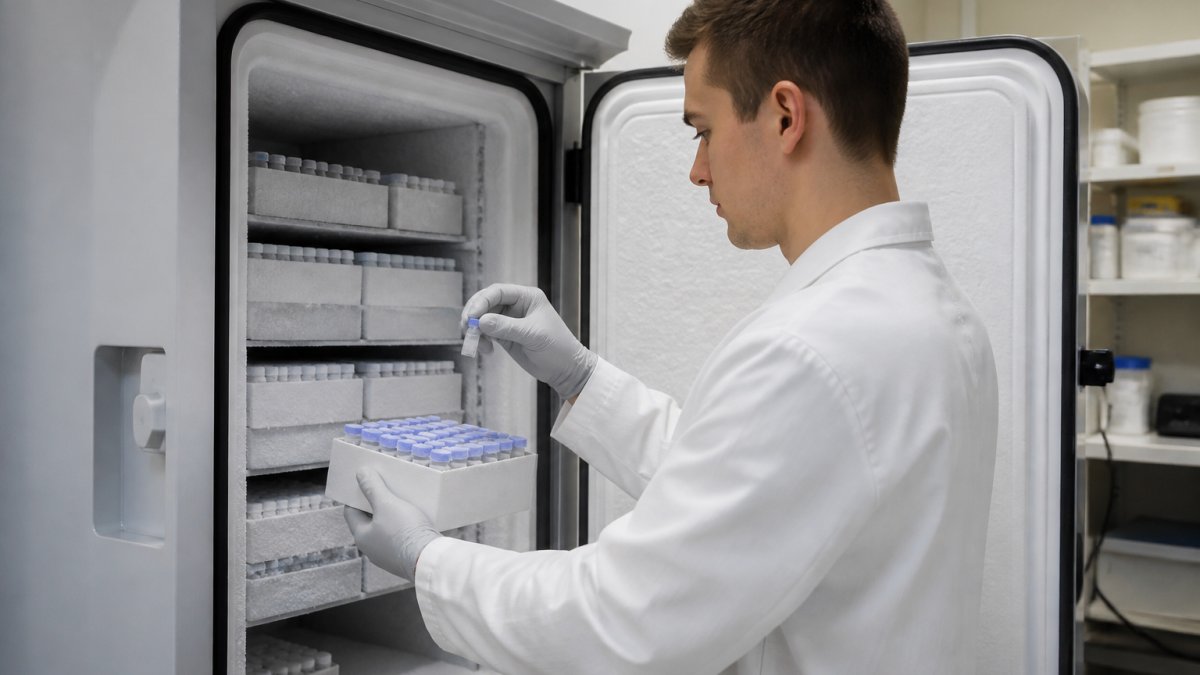
Once delivered, store peptides at -20°C (freezer) for months or -80°C (ultra-low freezer) for years (Recommendations for the generation, quantification, storage and handling of peptides used...). Room-temperature storage degrades most peptides within weeks. Humidity and light exposure accelerate degradation.
The supplier's CoA should specify recommended storage conditions. If it doesn't, ask directly.
Peptide storage and handling best practices
Choosing the right best peptide suppliers for metabolic research means prioritizing transparency, independent testing, and reliable logistics over catalog size or brand recognition. For research teams conducting time-sensitive metabolic studies, this combination eliminates delays and builds confidence in your data. VIEW PRODUCT
Frequently Asked Questions
How can I verify that a peptide supplier's certificate of analysis is actually independent?
Request documentation showing which third-party laboratory performed the analysis. Reputable peptide suppliers provide batch-specific CoA reports with HPLC or LC-MS results, the testing lab's name and credentials, and traceable batch numbers. Cross-reference the testing facility's accreditation (ISO 17025 certification for analytical labs strengthens credibility). Ask your supplier directly: which independent lab conducted this test, and can they provide contact information for verification? Suppliers who generate CoAs in-house without third-party verification may not meet the standards required for rigorous metabolic research.
What should I look for when comparing research peptide suppliers?
Evaluate suppliers across six dimensions: catalog breadth (do they stock metabolic and GLP-1 peptides your research needs?), purity specifications (research-grade or GMP-grade?), testing transparency (independent third-party analysis with HPLC/LC-MS methods?), documentation quality (batch-specific CoAs and manufacturer records?), fulfillment reliability (live inventory checks, accurate lead times, same-day or next-day shipping?), and customer responsiveness (can you reach someone quickly if a batch doesn't meet spec?). Compare at least three suppliers using these criteria to identify which aligns best with your lab's requirements and budget.
What purity testing methods should a peptide supplier use?
High-performance liquid chromatography (HPLC) and liquid chromatography-mass spectrometry (LC-MS) are the standard analytical verification methods for research peptides. HPLC identifies purity by separation and quantification; LC-MS confirms peptide identity and molecular weight. Reputable suppliers provide batch-specific results showing purity percentages (typically 95%+ for research-grade, 98%+ for GMP-grade). Request that suppliers include both methods in their testing protocols and provide full chromatograms in the certificate of analysis. This transparency allows you to independently verify claims and reproduce results across batches.
How should I store research peptides after delivery to maintain their stability?
Store research peptides in a -20°C freezer (or -80°C for long-term storage beyond 6 months) in sealed, airtight containers away from light and moisture. Keep documentation of storage temperature using a data logger if your research protocol requires it. Before use, allow peptides to reach room temperature gradually in a desiccator to prevent condensation. Avoid repeated freeze-thaw cycles; aliquot peptides into smaller portions if you use them frequently. Verify that your supplier shipped peptides with appropriate temperature control (insulated packaging, ice packs, or dry ice) to prevent degradation during transit. Improper storage or transit can compromise purity and affect your research results.
